1st Edition Pokemon Cards: What Are They Worth?
Most 1st edition Pokemon cards sell for a few dollars. A few, mostly Base Set holos in top grades, sell for thousands, and a PSA 10 Base Set Charizard sells for six figures. What separates them comes down to three things: which set the card is from, which card it is, and what shape it's in.
This guide shows you how to check each one on your own cards, using 1st edition Base Set Gyarados as the example, so you can price your binder instead of copying numbers off someone else's list.
Key takeaways
- Most 1st edition cards are worth a few dollars. Base Set holos like Charizard, Blastoise, and Gyarados are where the hundreds and thousands are.
- A real 1st edition stamp sits just under the bottom left corner of the artwork, and a real 1st edition Base Set card has no drop shadow next to the art.
- The set sets the floor, the card sets the ceiling, and condition multiplies everything.
- Only grade a card when the graded price, minus fees and shipping, beats the raw price by a clear margin.
- For exact numbers, use eBay sold listings and PriceCharting, not asking prices.
How do you tell if a Pokemon card is really 1st edition?
The stamp and where it sits
Look just under the artwork, on the left side. A 1st edition card has a small black circle with a "1" in it and the word "EDITION" under it. If that spot is blank, the card is an unlimited print, no matter how old it looks or how it was stored.
1st edition, shadowless, and unlimited Base Set
Base Set was printed several times, and only the first run carries the stamp:
- 1st edition: the stamp, and no drop shadow along the right edge of the art box.
- Shadowless: no stamp and no shadow. This was the early unlimited run, and it's worth more than a regular unlimited card but usually less than a 1st edition copy of the same card.
- Unlimited: no stamp, with a shadow along the right side of the art box. This is the most common printing.
- Later prints: a copyright line that reads 1999-2000 marks the 4th print, which sits at the bottom of the price range.
Fakes and added stamps
The most common fraud on valuable holos is a real unlimited card with a fake stamp added. The quickest check: a Base Set card with both a stamp and a drop shadow doesn't exist as a real 1st edition. Also look for a stamp that's too big, too small, smudged, out of its usual spot, or sitting on top of the print instead of being part of it. For expensive cards, buy them graded by PSA, CGC, or BGS, since the grader has already checked the stamp.
What makes one 1st edition card worth $5 and another worth $5,000?
The set sets the floor
Earlier sets had smaller print runs and fewer copies survived in clean condition, so a 1st edition common from Base Set starts higher than a 1st edition common from a later, more heavily printed set.
The card sets the ceiling
Within a set, the holo rares are the money cards. A 1st edition holo Charizard outprices a 1st edition common from the same pack by orders of magnitude, because demand piles onto the cards collectors remember from childhood. Commons trade for dollars; holos trade for hundreds or thousands depending on grade.
Condition multiplies both
| What you're checking | Low end | High end |
|---|---|---|
| Set | Later set, big print run | Base Set, early print run |
| Card | Non-holo common | Holo rare |
| Condition | Played, raw | PSA 10 |
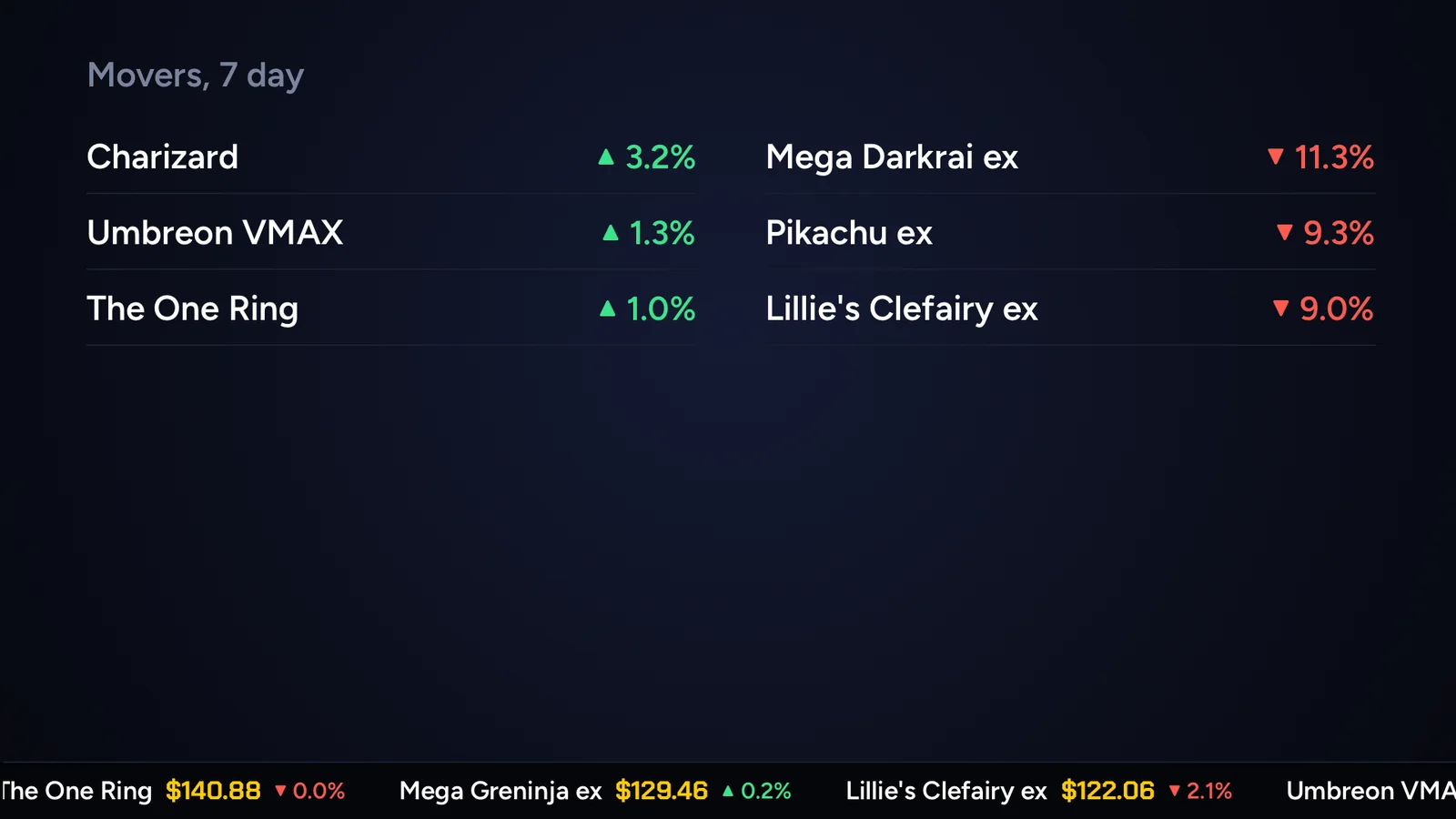
Want prices like these for your own cards, on your TV and refreshed daily? Claim a tester spot
How much is a 1st edition Gyarados worth, and why does the set matter?
Base Set Gyarados is the benchmark
Base Set 1st edition Gyarados (6/102) is the one people mean. A clean raw copy sells well above most Base Set holos, and gem mint copies sell for a big premium because so few survived with good centering and a clean holo. The price moves week to week, so look up a live price before you quote one.
Same Pokemon, different card, different money
"1st edition Gyarados" can mean more than one card:
- Base Set Gyarados (6/102): the benchmark above.
- Dark Gyarados (8/82), Team Rocket: a different card from a later set, in a lower price bracket.
- Misty's Gyarados (13/132), Gym Challenge: another holo with a 1st edition run, also priced well below Base Set.
Same Pokemon, different prices. That's why a price check has to go by set and card number, not just the name. The Jolteon guide walks through the same thing for a Jungle holo with dozens of printings. TCG Marquee looks cards up that way for every game it covers, which I wrote about in More than Pokemon.
How does condition and grading change the price?
Raw condition tiers
Raw cards sell in tiers: near mint, lightly played, moderately played, and damaged. On a 1st edition Base Set holo, each step down can cut the price by a third or more, because buyers haggle over every bit of whitening and every edge chip. A card worth $80 near mint might sell for $50 lightly played and struggle to reach $30 moderately played.
PSA 10 vs PSA 8: the cliff
Grading doesn't add value in a straight line. PSA's population report shows how many copies of a card exist at each grade, and for Base Set, 10s are far scarcer than 8s. That gap is where the money is: a PSA 8 can sell near raw near mint money, while a PSA 10 of the same card can sell for many times more. CGC and BGS work the same way, with BGS black labels and CGC pristine labels adding a tier at the very top.
When is it worth getting a 1st edition card graded?
Do one sum: what you expect the card to sell for graded, minus grading fees, shipping both ways, and insurance, compared with what it sells for raw today. If the difference is small, keep it raw.
Fees change often, so check PSA's own fee page before you send anything. As of September 2026, PSA had paused its cheaper Value tiers (about $25 to $33 a card) and its cheapest open tier was $79.99 a card. At those prices, a card that grades 8 either way just moves money to the grader.
Two rules for a card table:
- Grade cards you believe are 9s or 10s, and check the population report first to make sure that grade carries a real premium.
- Never grade a card whose raw price already reflects its condition. If you can't call the grade within one point, it's a coin flip.
Where can you check current 1st edition prices?
Sold prices, not asking prices
Two numbers matter: what cards actually sold for, and what sellers are asking. eBay sold listings (filter to "Sold items") give you the first. PriceCharting tracks those sold prices over time and splits them by condition and grade, and its Base Set pages list 1st edition, shadowless, and unlimited separately, which is exactly the split that turns a $50 card into a four figure one. Printed price guides fall behind; sold data moves weekly.
Keeping a show table price board current
Looking up each card by hand works for a few slabs, not a table full of singles. That's the problem TCG Marquee was built for. It prices your cards automatically every day, shows the total value of your collection, and with show mode puts your asking price next to the market price on a TV at your table, with your logo and a QR code for buyers.
To be fair about it: TCG Marquee is in beta, and it's not a sales history archive. When a buyer wants to see what a card sold for three months ago, PriceCharting and eBay sold listings are still the place to look.
How do you price a whole binder without losing an afternoon?
Work in a fixed order:
- Sort the binder by set, since prices live at the set and card level.
- Check each holo for the stamp and the shadow before you look up a price.
- Scan the cards rather than typing them in. TCG Marquee scans cards with your phone's camera, several in a row, and you pick the printing and condition before they go in.
- Pull out anything worth more than a grading fee and look at it closely under good light.
FAQ
How much is a 1st edition Pokemon card worth?
Most sell for a few dollars. The real money is in Base Set holos: raw copies of Charizard, Blastoise, and Gyarados sell in the hundreds or more, and PSA 10 copies reach four to six figures. The price depends on the set, the card, and the grade.
How much is a 1st edition Gyarados worth?
Base Set 1st edition Gyarados (6/102) is the benchmark, and clean copies sell well above most Base Set holos, with big premiums for high grades. Dark Gyarados from Team Rocket and Misty's Gyarados from Gym Challenge also come in 1st edition, and both sell for much less.
Is a shadowless card worth more?
A shadowless Base Set card is worth more than a regular unlimited one, but it has no 1st edition stamp and usually sells for less than a 1st edition copy. A card with a drop shadow and no stamp is a regular unlimited print.
How can you tell if a Pokemon card is 1st edition?
Look just under the bottom left of the artwork for a small black circle with a 1 in it and EDITION under it. On Base Set, a real 1st edition card has no drop shadow next to the art, so a stamp plus a shadow means the stamp was added.
Are 1st edition Pokemon cards still valuable?
Yes, but selectively. Early sets and holo rares carry the premiums, while 1st edition commons trade for dollars. Condition matters most of all: each step down in raw condition can cut the price by a third, and PSA 10s sit far above everything else.