Pokemon Card Prices: Which Sources Sellers Trust
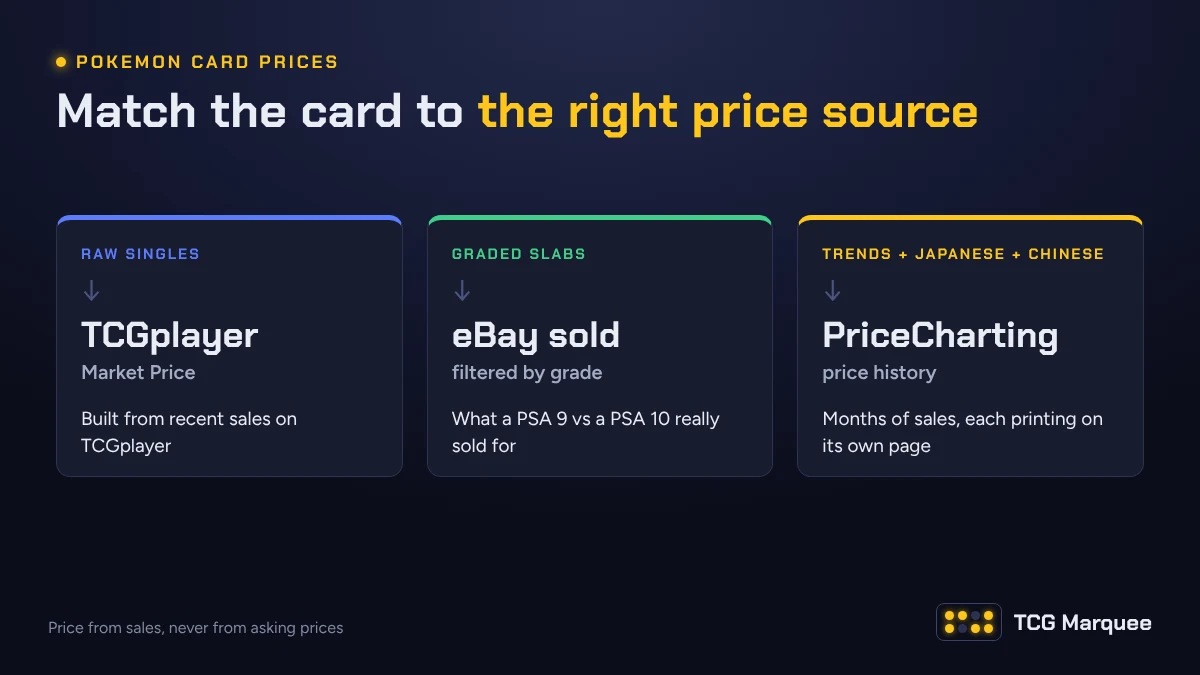
No single site gives reliable Pokemon card prices for everything on a seller's table, because raw singles, graded slabs, and Japanese or Chinese printings each sell in different places. The fix is simple: match each kind of card to the source that tracks it best, and price from recent sales, never from what other sellers are asking.
Key takeaways
- TCGplayer's Market Price is built from recent completed sales on TCGplayer, which makes it a good check for raw English singles.
- For graded slabs, use eBay sold listings for the exact card, grading company, and grade, or PriceCharting's graded prices.
- PriceCharting is the easiest place to see a card's price over months and years, and it lists Japanese and Chinese printings as their own sets.
- A slab's price depends on the grade and on how many copies exist at that grade, so check the PSA population report before you set a number.
- For a new set with few sales, use the median of recent sales and expect it to move.
Prices in this guide were checked on PriceCharting in October 2026. They change daily, so look up your own card before you price it.
Where can you check Pokemon card prices reliably?
Three sources cover most tables: TCGplayer, eBay sold listings, and PriceCharting. Each is best at a different kind of card, and using the wrong one is how sellers underprice or sit on stock.
Raw singles: TCGplayer Market Price
TCGplayer shows several numbers on each card. Market Price is "compiled from recent sales completed on TCGplayer.com," while Listed Median is the middle of current asking prices, which "can vary significantly from the actual price that people are paying" (TCGplayer help). For raw English cards from recent sets, Market Price is the one to use. Check the condition it's for, since a near mint price isn't a lightly played price.
Slabs: eBay sold listings by grade
TCGplayer is built around raw cards. For PSA, CGC, BGS, and other slabs, eBay's sold listings are where you see what a PSA 9 actually sold for next to a PSA 10. Search the exact card name and number, add the grading company and grade, and filter to sold items.
PriceCharting for trends
PriceCharting builds its prices from completed sales and shows ungraded and graded prices on the same page, with a chart going back months or years. That makes it the pick for older cards, for checking whether a price is holding or drifting, and for printings TCGplayer doesn't cover well.
| Card type | Best source | Why |
|---|---|---|
| Raw, recent English sets | TCGplayer Market Price | Recent completed sales on TCGplayer |
| Graded slabs | eBay sold, filtered by grade | Sales for that exact grade |
| Older cards, trends | PriceCharting | Sales history over time |
| Japanese and Chinese printings | PriceCharting's own set pages | Listed as separate sets |
Want prices like these for your own cards, on your TV and refreshed daily? Claim a tester spot
How do graded card prices differ from raw card prices?
A PSA 10 and a raw copy of the same card are priced from different sales, because a grade changes what the buyer is paying for. A raw card sells on a condition range (near mint, lightly played, and so on) that the buyer judges from photos or in hand. A slab sells on a fixed grade, plus how many other copies have that same grade.
Why population and grade matter
Two cards with the same grade can sell very differently if one has a few hundred copies at that grade and the other has tens of thousands. Scarcity at the grade is part of the price, not just the number on the label. On some modern cards, so many copies grade well that a 9 sells for little more than a clean raw copy. Destined Rivals' Team Rocket's Mewtwo ex (#231) shows this: on October 25, 2026, PriceCharting had it at $372.49 raw, $433.00 in grade 9, and $877.50 in PSA 10 (PriceCharting, Destined Rivals).
PSA publishes how many copies of each card it has graded at each grade in its population report. Look up your card there before you set a price on a slab.
Read sold listings, not asking prices
For slabs, read the last several sales of the same grade, not current listings. Asking prices on graded cards often run high. For raw cards, ignore sold listings whose photos hide the edges and surface; a sale only tells you something if the card looks like yours.
What are Pokemon Destined Rivals card prices right now?
Destined Rivals came out on May 30, 2025 (Bulbapedia). On October 25, 2026, the top singles on PriceCharting were:
| Card | Raw | Grade 9 | PSA 10 |
|---|---|---|---|
| Team Rocket's Mewtwo ex (#231) | $372.49 | $433.00 | $877.50 |
| Cynthia's Garchomp ex (#232) | $174.99 | $175.75 | $369.00 |
| Ethan's Ho-Oh ex (#230) | $142.49 | $144.00 | $292.50 |
Notice how close the raw and grade 9 prices are on all three. On cards like these, a 9 adds little; the jump is at 10.
Which cards hold value
On most sets, the big secret rares and special illustration rares hold up, while most regular rares fall to a dollar or two within a few months of release. Price the hits individually and put a flat rate on the rest. The Pitch Black guide shows how that looks on one set, secret rares and all. Promos and staff stamped cards are their own listings (on October 25, 2026, PriceCharting had a Regional Staff Team Rocket's Giovanni at $700.00), so check for a stamp before you price a card as the regular version.
Pricing a master set binder
Master set collectors price the whole binder, not card by card. Price the hits from sales, put a flat rate on the rest, and add it up. TCG Marquee does that total for you every day if your binder is in it.
How do you price 25th Anniversary Pokemon cards?
The 25th anniversary sets come in two families that aren't the same product:
- Celebrations (English), released October 8, 2021: a 25 card main set plus the 25 card Classic Collection of reprinted older cards.
- 25th Anniversary Collection (Japanese), released October 22, 2021: 30 cards. The Japanese version of the Classic Collection reprints came separately, in single-card promo packs.
Because the sets and their numbers differ, search each printing separately and compare sales within its own set. A Japanese copy and an English copy of the same Pokemon can sell for very different amounts. If you track both in one collection, set the right set on each card, so each one is priced from its own market.
Are simplified Chinese Pokemon card prices comparable to English sets?
Usually not. Simplified Chinese cards have their own sets and their own buyers, with far fewer sales to price from, so the English price of the same card doesn't tell you much.
The trap is a lookup that lumps every language under one name. PriceCharting avoids that by listing Chinese sets as their own "Pokemon Chinese" pages, separate from English and Japanese. Its Chinese 25th anniversary set, for example, had a Mew (#30) at $32.69 raw on October 25, 2026 (PriceCharting, Chinese s8a). Simplified Chinese (mainland China) and traditional Chinese releases are different products too, so make sure you're looking at the same release as your card, never the English default. On a price board, list them as separate cards with their own asking prices.
What are Pitch Black Pokemon cards worth?
Pitch Black is a Mega Evolution series set that came out on July 17, 2026: 84 cards plus 36 secret cards, 120 in all. Its Japanese counterpart is Abyss Eye (Bulbapedia, Pitch Black).
On October 25, 2026, the top singles on PriceCharting were:
| Card | Raw | Grade 9 | PSA 10 |
|---|---|---|---|
| Mega Darkrai ex (#116) | $166.82 | $195.82 | $710.60 |
| Mega Darkrai ex (#120) | $146.33 | $229.21 | $1,318.12 |
| Morpeko ex (#117) | $62.59 | $175.63 | $599.99 |
| Mega Zeraora ex (#114) | $44.34 | $99.00 | $408.63 |
The set is only three months old, so there are few graded sales and the PSA 10 numbers can move a lot on one sale. For a new set: take the recent sold listings, throw out the highest and lowest, and price near the middle. Recheck weekly while the set is still being opened.
How do you set a Pokemon card selling price without underselling?
Show the asking price next to the market price
The market price is what recent copies sold for. Your asking price is what you'll take. Showing both on your table makes your price easy to trust: a buyer can see you're at market, or under it, without pulling out their phone. If you're asking over market for a good reason (a better copy, a hard to find card), say so on the tag.
When to hold a slab and when to sell
Holding makes more sense when the slab is scarce at its grade and its sales have been steady or rising. Selling makes more sense when there are many copies at that grade, its last several sales are each lower than the one before, or you need the cash for new stock. Either way, decide from sales, not from what the card cost you.
If you sell online too, the fees come off your side: eBay's final value fee and TCGplayer's fees change, so check their current pages before you price a card to sell there. Grading fees change too, so check PSA's current prices before you decide a card is worth grading. The first edition guide walks through grading costs against the price gap between grades.
Which tool keeps a whole collection priced without manual lookups?
Any tool is only as good as the sales behind it. TCG Marquee refreshes prices every day for each card's printing and condition, and for slabs by grading company and grade on the Pro plan. It shows your collection's total, the week's movers, and in show mode your asking price next to the market price on a TV or screen at your table. You can add cards by scanning them with your phone.
What it doesn't do: it isn't a sales history archive, so for every past sale of a card use eBay sold listings or PriceCharting. Cards with very few sales, like brand new sets and some Chinese printings, still need a sold listing check by hand. TCG Marquee is in open beta, so compare its prices with a few sold listings before you rely on it. For more on graded prices, see graded card prices and the two plans.
FAQ
What is the best site for Pokemon card prices?
It depends on the card. TCGplayer's Market Price works well for raw English singles from recent sets, eBay sold listings for graded slabs, and PriceCharting for older cards, price history, and Japanese and Chinese printings. Always price from sales, not asking prices.
How much is my Pokemon card worth graded PSA 9 instead of 10?
Look at the last few PSA 9 sales of your exact card on eBay or PriceCharting. On many modern cards a 9 sells for close to the raw price while a 10 sells for several times as much. On scarcer cards, a 9 can still be worth far more than raw.
Do Pokemon card prices change after a set goes out of print?
Often, yes. While a set is being opened, supply keeps coming and most cards slide. Once it's out of print, the top cards often firm up, while regular rares stay cheap. Recheck your hits often and the rest now and then.
Is it worth grading a card to get a higher price?
Sometimes. Check the population report and recent sales at each grade. If a 9 sells for about the raw price and you're not sure the card is a 10, grading fees can eat the gain. If the card is scarce in high grades and yours is clean, grading can pay well.
How do I price a whole binder fast before a show?
Pull the hits (holo rares, ex cards, illustration rares, anything numbered above the set's total), price those from recent sales, and put a flat rate on the rest. A tool that keeps the binder's total current, like TCG Marquee, saves the lookups for the cards that matter.