PSA 10 Pokemon Card Value: Price Any Slab for Free
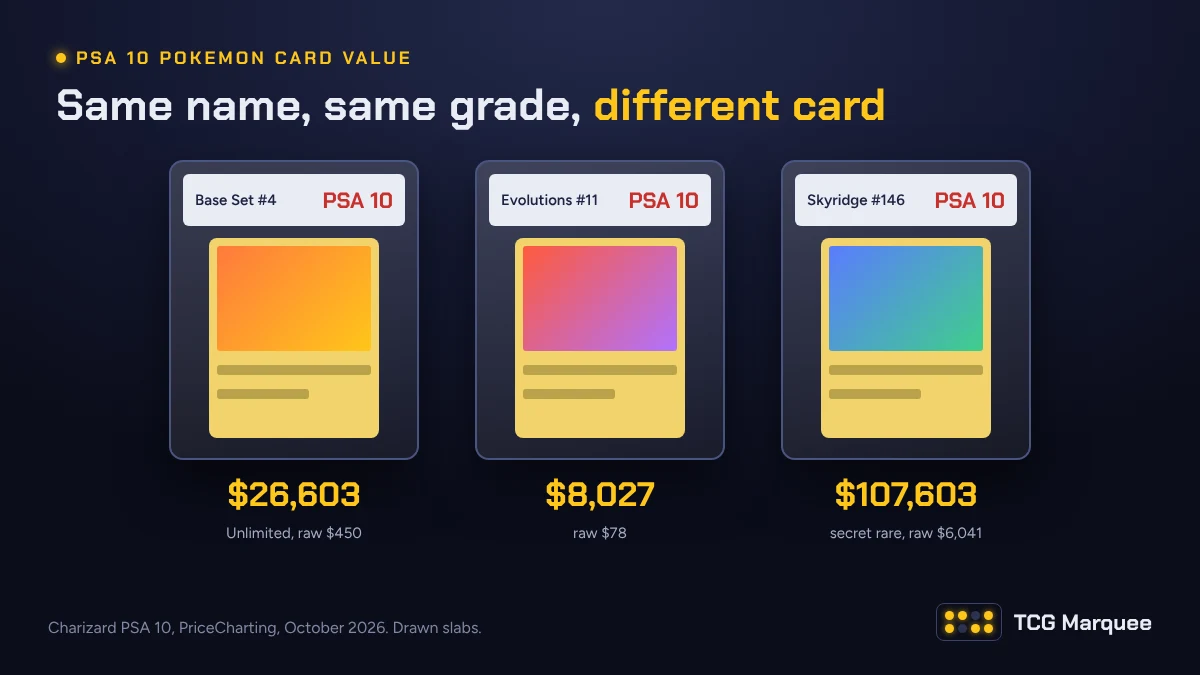
PSA 10 Pokemon card value comes from recent sold prices for that exact card and grade, not from asking prices. Verify the slab's cert number on PSA's free lookup, read eBay sold listings filtered to PSA 10, and cross-check PriceCharting. This guide walks through that with Charizard as the example, then gives a short checklist for telling whether a price quote is solid or stale.
Key takeaways
- PSA 10 Pokemon card value comes from recent sold listings for the exact card and grade, never from asking prices.
- Verify the cert number on PSA's free lookup first, so you know the exact set and printing you're pricing.
- Cross-check eBay sold listings against PriceCharting. When they disagree, trust the more recent sales with the tighter spread.
- Test every quote for recency, number of sales, spread, and direction, and price conservatively when it fails.
- Free lookups are fine for one slab. Keeping a whole case priced before a show is where a live price board helps.
Prices in this guide were checked on PriceCharting in October 2026. They change daily, so look up your own card before you price it.
What does a PSA 10 grade mean for a card's value?
PSA 10 is Gem Mint, PSA's top grade. Because a 10 has to be close to perfect, far fewer cards earn it than earn a 9, and buyers pay for that scarcity. The gap between a 9 and a 10 is often the biggest jump in a card's whole price range.
Why two PSA 10s with the same name sell for different prices
"Charizard PSA 10" isn't one card. Charizard has been printed in dozens of sets since 1999, and each printing has its own population, its own buyers, and its own price. The same printing can also come in variants (1st Edition, shadowless, reverse holo, prerelease stamps), and each variant is its own market. Before you compare sales, make sure every comp is the same set, number, and variant as your slab.
How do you look up PSA 10 Pokemon card value for free?
Three free tools cover most slabs: PSA's cert lookup, eBay sold listings, and PriceCharting.
Step 1: verify the cert on PSA's free lookup
Enter the cert number from the label on PSA's cert verification page. It shows the card PSA graded, its set, grade, and label details, and it helps you spot a fake slab whose label doesn't match PSA's record. Get the set and variant straight here before you price anything.
Step 2: pull eBay sold listings for the exact grade
Search eBay for the card name and number plus "PSA 10", then turn on the Sold Items filter. Narrow it with the grader and grade filters on the left so raw copies and PSA 9s drop out, and sort by newest first. Read the last several sales and note the range.
Step 3: cross-check PriceCharting
PriceCharting shows ungraded and graded prices for each card, including PSA 10, built from completed sales, with a chart over time. If its number agrees with your eBay range, you have a solid price. If they disagree, look at dates and trust the more recent sales.
Doing this for one slab takes a few minutes. Doing it for fifty before a show takes the morning, which is the problem TCG Marquee was started to solve.
What is a PSA 10 Charizard worth, and why does the answer vary?
Here are three Charizard printings from PriceCharting in October 2026. Same name, same grade, very different prices:
| Charizard printing | Raw | Grade 9 | PSA 10 |
|---|---|---|---|
| Base Set Unlimited (#4) | $449.71 | $3,595.95 | $26,603.23 |
| Evolutions (#11) | $78.15 | $224.86 | $8,026.50 |
| Skyridge secret rare (#146) | $6,040.90 | $39,800.00 | $107,602.75 |
Want prices like these for your own cards, on your TV and refreshed daily? Claim a tester spot
(PriceCharting, Base Set, Evolutions, Skyridge)
Two things stand out. First, the modern Evolutions Charizard sells for about $78 raw but over $8,000 in PSA 10: a 10 can be worth a hundred times the raw card. Second, an older e-Card era Charizard like Skyridge's is worth far more than either, even raw. Pricing by name alone would be off by tens of thousands of dollars. For the most valuable Base Set printing, the 1st Edition Charizard guide has the price at every grade.
Why you'll see three different numbers in ten minutes
The differences stack up from three places. Raw versus graded: a slab is priced from slab sales. Printing: each set and variant is its own market. Timing: a sale from last week and a sale from last spring can be far apart. When two tables quote different prices for "the same" slab, they're often pricing different printings, different graders, or different months. Confirm the set, grader, and sale date on every comp you use.
How do you read sold listings versus asking prices?
Asking prices are what sellers hope for. A PSA 10 listed at $900 for three months without selling tells you $900 is too high. Only completed sales show what buyers paid.
Filtering to sold listings and graded copies
On eBay, filter to Sold Items, then to the grader and grade you need. Three or four recent sales from different sellers give you a working range for your slab. On PriceCharting, open the card's own page and read the graded prices and the sales behind them.
Spotting sales you shouldn't trust
Not every sale is a clean comp. Be wary of a sale far above every other recent one, an auction with a single bid, a listing with no photos of the actual slab, or photos reused from another listing. Leave outliers out and price from the cluster.
How do set, year, and population affect a PSA 10's price?
PSA's population report counts how many copies of each card it has graded at each grade, and it updates daily. A small PSA 10 population means buyers compete for few copies. A large one means buyers can wait for the cheapest. Check the population for your exact card and grade before you set a price.
Modern print runs vs vintage scarcity
Old cards that survived decades in gem condition are rare in a 10. Modern cards are printed in far bigger runs and are often graded straight from the pack, so some have large PSA 10 populations. Even so, a modern 10 can carry a big premium over raw, as the Evolutions Charizard shows. Check the population and the sales; don't assume from the card's age.
When is a PSA 10 price quote unreliable or stale?
A four point check
Run every quote through these before you trust it. The thresholds are a rule of thumb; adjust them for how often your card sells.
| Check | What to look at | Good sign | Warning sign |
|---|---|---|---|
| Recency | Date of the last sale | Sold in the last few weeks | Nothing sold in months |
| Number of sales | Recent sales at this grade | Several in the last month | One sale, months old |
| Spread | Gap between low and high sales | Sales cluster close together | One sale doubles the next |
| Direction | The last few sales in order | Flat or a slow drift | A sudden jump with no reason |
A quote that passes all four is a market price. One that fails is closer to a guess.
Red flags in a price quote
- No sale date shown, so you can't judge recency.
- One sale driving the whole number.
- Recent sales spread wide, like $400 to $900, where an average means little.
- Asking prices counted as sales.
- The wrong grader or grade, like a BGS 9.5 used as a PSA 10 comp.
When two sources disagree, trust the one with more recent sales and a tighter spread. If neither passes, price at the conservative end until the market settles.
Do you need a paid app to value graded cards?
For one slab, no. PSA's cert lookup and population report, eBay sold listings, and PriceCharting are free and cover most of it. Free lookups fall short on repetition: pricing a full case for Saturday means dozens of searches, and Friday's numbers can be stale by Sunday.
Where a live price board helps at a show table
TCG Marquee refreshes prices every day for each card's printing and condition, and on the Pro plan for slabs by grading company and grade (PSA, CGC, BGS, TAG, SGC, and ACE). Show mode puts your asking price next to the market price on a TV or screen at your table, with your logo and a QR code. You can add cards by scanning them with your phone. For more on graded pricing, see graded card prices and the two plans.
What it doesn't do: it isn't a sales history archive, so for the individual sales behind a price, use eBay sold listings or PriceCharting, and a high value slab still deserves a sold listing check by hand. TCG Marquee is in open beta.
How do you turn a valuation into an asking price at a show table?
Matching market vs pricing above it
Once you have a market number, decide how your asking price relates to it. Matching market moves cards faster. Pricing above it can make sense on scarce slabs where you can wait for the right buyer. Whatever you choose, apply it the same way across your case so your board is consistent for the whole weekend.
Show buyers the number you're basing it on
Buyers trust a table faster when they can see where your price came from. Put the market price next to your asking price so the gap is visible and you can explain it. If a card hasn't moved in weeks and its market has dropped, update the board before a buyer points it out.
FAQ
How much is my PSA 10 Pokemon card worth right now?
Check eBay sold listings for the exact card name, number, and "PSA 10", newest first. Read the last several sales and note where they cluster. Cross-check PriceCharting, and if the two disagree, trust the more recent sales.
Why do two PSA 10s of the same card sell for different prices?
Usually they aren't the same card. Different sets, variants, and stamps are different markets, even with the same Pokemon on them. Verify the cert on PSA's lookup and compare only sales of the same set, number, and variant. Timing matters too: prices move.
Are asking prices a reliable guide to value?
No. An unsold listing shows what a seller hopes to get. Only completed sales count, and even those need a look: skip single bid auctions, listings without real photos, and any sale far above every other recent one.
When should I treat a price quote as stale?
When the last sale is months old, there are only one or two sales, the sales are spread far apart, or the latest sale jumped with no reason. A quote with no sale date, or one built on asking prices, fails outright.