Pokemon TCG Market Price: What It Means for Vendors
Pokemon TCG market price is not one number. TCGplayer's Market Price, eBay sold listings, and graded sales each answer a different question about the same card, so a vendor who prices a slab off the raw number, or a raw card off one odd sale, leaves money on the table or scares off a buyer. This guide explains each source, shows one card priced three ways, and gives a rule of thumb for which number to trust at each price tier.
Key takeaways
- TCGplayer's Market Price is built from recent completed sales on TCGplayer, not from the cheapest listing or from asking prices.
- eBay sold listings show what cards actually sold for across the whole market, but lots, bundles, and odd sales have to be filtered out.
- A graded slab sells on its own market. A PSA 10 is never the raw price plus a fixed premium.
- As a rule of thumb: trust TCGplayer under about $50, cross-check sold listings from $50 to $500, and build graded prices from comps above that.
- Thin markets swing on single sales, so price from the middle of several recent sales, not the last one.
Prices in this guide were checked on PriceCharting in October 2026. They change daily, so look up your own card before you price it.
What does Pokemon TCG market price actually mean?
"Market price" is shorthand for what a card has recently sold for. Every price board, scanner app, and collection tracker gets its number from somewhere, and for most sellers that somewhere is one of three places: TCGplayer, eBay sold listings, or graded sales. Knowing which one you're looking at is the difference between a fair price and a bad one.
Why the same card shows different numbers on different sites
Each source counts a different pool of sales. TCGplayer counts sales on TCGplayer, mostly raw cards. eBay counts auctions and fixed price sales from everyone, raw and graded mixed together until you filter them. Graded price guides like PriceCharting split sales by grade. The same card can land at three different numbers, and all three can be right for what they measure.
How is TCGplayer market price calculated?
TCGplayer says its Market Price "is compiled from recent sales completed on TCGplayer.com" and is updated as transactions complete. It is a sales number, not a listing number. TCGplayer also shows a Listed Median, which is the middle of current asking prices only (TCGplayer help).
Listing price vs market price
This gap is where vendors lose sales. A card can sit at $12 in twenty stores while its Market Price is near $8, because the copies that actually sold went for about $8. A buyer at your table checks the TCGplayer app, sees $8, and your $12 sticker looks high even if your copy is clean. Know the market number before you set the sticker, and if you're over it for a reason (a better copy, a hard to find printing), say so.
Market price vs the lowest listing
The lowest listing is just the cheapest copy for sale right now. It can be a damaged copy, a seller with slow shipping, or one copy left at a price nobody else matches. Treat it as a floor signal, not a comp. Market Price is the better baseline.
When TCGplayer market price is less reliable
Market Price is only as good as the sales behind it. When a card trades rarely, a single sale can move it a lot, and a number built on two sales last month isn't a market. For low print chase cards and anything new, use TCGplayer as a starting point and check sold listings before you commit.
What do eBay sold listings tell you?
eBay sold listings show what a card actually changed hands for, across auctions and fixed price sales from every kind of seller. That makes them the widest view of the market, and the best place to find sales of graded cards at an exact grade. Search the card name and number, then filter to sold items.
Filtering bundles, lots, and odd sales
Sold results carry junk you have to strip out: lots of 100 commons, sealed bundles, proxies, and cards that sold inside a lot. Read the titles and photos, not just the prices. A sale only tells you something if the item looks like yours.
One sale is a data point, not a price
One panic sale or one inflated bid can move a single result a long way. Read the last five to ten sales of the same card and condition, look at the spread, and price from the middle. Tools that average sold data save time, but an average hides the outliers you need to see, so spot check the sales yourself on anything that matters.
Why isn't a PSA 9 priced off the raw chart?
A graded slab trades on its own market. Buyers pay for a fixed grade and for how scarce that grade is, so the gap between raw and graded is different for every card. PSA's population report counts how many copies of each card it has graded at each grade. A card with a huge PSA 10 population sells closer to raw; a card with few 10s carries a premium the raw chart can't show you.
PSA, BGS, and CGC slabs are separate markets
The same card at the same number from different graders can sell for different amounts. Price a PSA 10, a BGS 9.5, and a CGC 10 each from sales of that exact grader and grade, never from one another.
Where graded comps live
eBay sold listings filtered by grader and grade are the freshest comps. PriceCharting shows ungraded and graded prices on the same card page, built from completed sales, with a chart over time. Use both, and when they disagree, look at the dates: the more recent sales usually win.
The same card, priced three ways
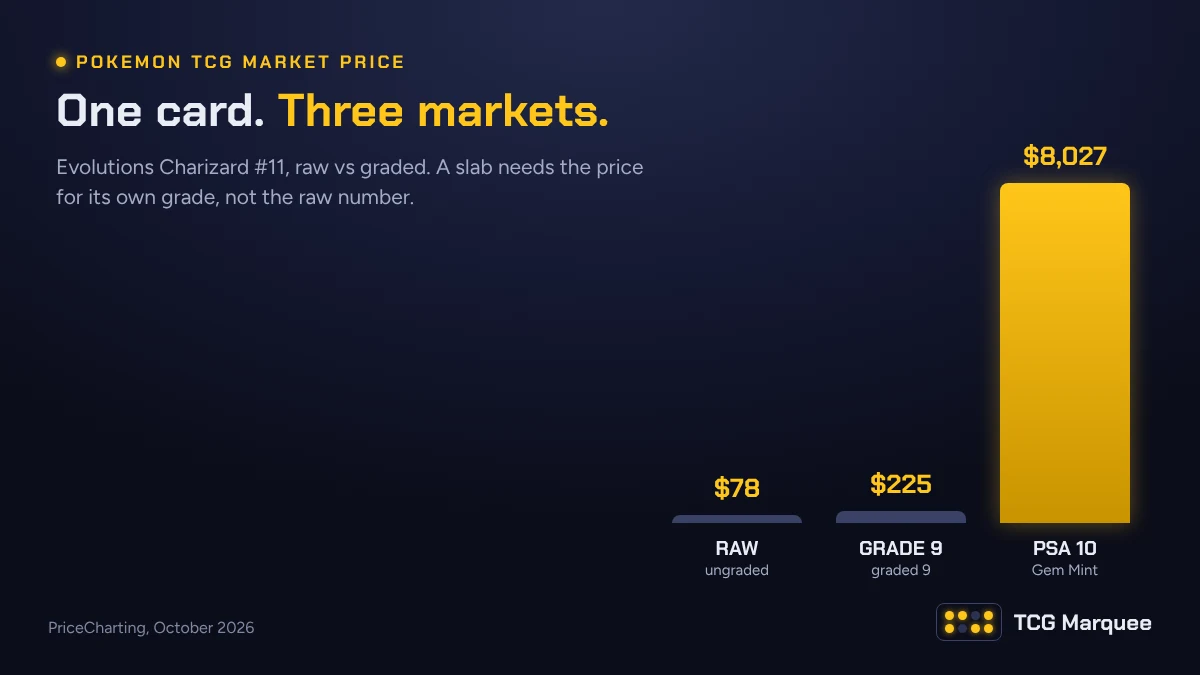
Here is one real card, the Evolutions Charizard (#11), from PriceCharting in October 2026 (PriceCharting, Evolutions):
| Version | What it measures | October 2026 price |
|---|---|---|
| Raw (ungraded) | Sales of ungraded copies | $78.15 |
| Grade 9 | Sales of copies graded 9 | $224.86 |
| PSA 10 | Sales of PSA 10 slabs | $8,026.50 |
Want prices like these for your own cards, on your TV and refreshed daily? Claim a tester spot
The raw card and the PSA 10 are about a hundred times apart. Nobody would guess $8,026.50 from a $78 raw price, and a board that showed the raw number next to a PSA 10 in your case would be quoting a price for an item that isn't there. That's why a graded slab needs a graded price, at its exact grade.
Which price source should you trust at each tier?
These bands are a rule of thumb, not a law. The point is that the more a card is worth, the more checking it deserves.
Under $50: TCGplayer is usually fine
Cheap cards sell often, so Market Price tracks reality closely. Price from it, round to sensible table numbers, and move on.
$50 to $500: cross-check sold listings
Here the gaps start to matter. A mid tier card's Market Price can lag a fast move, or rest on a few sales. Before you set an asking price, read the last few sold listings. If they keep beating TCGplayer, the sold listings are your market.
$500 and up: build a price from graded comps
For high end slabs, the raw price tells you almost nothing, and graded sales can be few and far apart. Pull every recent sale at the exact grader and grade, note the dates, and give the newest the most weight. If a card was regraded or relisted between sales, find out why. Your asking price at this tier is a claim you can back up, not a number you copied. Price with room to negotiate, and expect buyers who collect slabs to know the comps too.
Does the framework change for One Piece, Lorcana, and other games?
The idea is the same, but the tiers shift. Newer games and smaller sets have fewer sales per card, so one sale moves the number more. Price from the median of several recent sales, not the last one, and hold your asking price a little firmer than you would on a Pokemon staple that sells every day.
Pokemon TCG Pocket is a different market
Pocket cards are digital and live in the app. They don't feed physical card prices, so don't let a Pocket card's popularity anchor the number on a physical copy.
How do you show asking price vs market price at your table?
Every show table gets the same question: what's it worth? A buyer who can't see a number checks their phone, then either haggles from whatever number they found or walks. A visible board removes that step. When the buyer can see you already priced against the market, the conversation starts from your number.
What a price board needs to show
Three things per card: your asking price, the current market price, and how far apart they are. For slabs, the market price has to match the grader and grade. A short list of the week's movers helps too, because buyers drift toward what's climbing.
TCG Marquee is built for this. Prices refresh every day for each card's printing and condition, and for slabs by grading company and grade on the Pro plan. Show mode puts your asking price next to the market price on a TV or screen at your table, with your logo and a QR code, and you can hide the market price on any card where you'd rather not show it. You can add cards by scanning them with your phone.
What it doesn't do: it isn't a sales history archive, so for every past sale of a card use eBay sold listings or PriceCharting, and very thin cards still need a sold listing check by hand. TCG Marquee is in open beta. For more on matching cards to sources, see which price sources sellers trust.
FAQ
Is TCGplayer market price the same as eBay sold price?
No. TCGplayer's Market Price is built from recent sales on TCGplayer only, while eBay sold listings cover auctions and fixed price sales across eBay. On cheap cards they usually land close. They drift apart more in the middle tiers, where a few sales can move either one.
Should I price my PSA 10 slabs off raw card prices?
No. A slab sells on the graded market, where the grade and how many copies share it set the price. Pull sold listings for the exact grader and grade, and price the slab from those.
What is the difference between market price and the lowest price on TCGplayer?
Market Price comes from recent completed sales. The lowest price is just the cheapest copy listed right now, which may be damaged, slow to ship, or the last one at that price. Use Market Price as your baseline and the lowest listing as a floor signal.
How do you price cards with no recent sales?
Build a price instead of copying one. Look at older sales and adjust for how the market has moved since, check nearby grades or conditions of the same card, and look at similar cards from the same set. Set a number you can explain, and expect to negotiate.