What Is a Pokemon Trading Card Game Worth? A Vendor's Guide
A Pokemon trading card game worth check comes down to what copies actually sold for, not what sellers are asking. Check sold listings for the exact printing, condition, and grade, cross-check a second source, and you have a number you can defend at your table or in your binder. This guide walks through one card, then a whole collection, then pricing a show table.
Key takeaways
- Sold prices are the market. Asking prices on live listings are hopes. Read three to five recent sales of the same card, not the single highest one.
- The card number and set identify the printing, and 1st Edition, shadowless, Unlimited, and reprints all sell at very different prices.
- Grading only pays when the graded price minus PSA's fee (and shipping) clearly beats the raw price. In October 2026 PSA's cheapest open tier was $59.99 a card.
- Value a whole collection top down: let an app total the bulk, then check the top 10 cards by hand.
- A graded slab has its own price. Never price a PSA 9 from the raw number.
Prices and fees in this guide were checked in October 2026. They change, so look up your own card before you price it.
How do you find out what a Pokemon trading card game card is worth?
Search the exact card, filter to sold listings, and read the middle of the results. eBay's sold filter shows completed sales, which makes it a record of what buyers paid. PriceCharting shows the same kind of data as a chart over time, split into ungraded and graded prices.
Sold price vs asking price
Here's an example with made-up prices: a raw card listed at $500 by a dozen sellers, whose last five sales landed between $330 and $370. The card is worth about $350. The $500 listings are noise, and a buyer who checks sold listings on their phone will know it. Compare three to five recent sales in the same condition, and when one sale is far from the rest, find out why before you trust it.
Why the card number and set matter before you search
Same name, very different prices. The number at the bottom of the card, like 4/102 for Base Set Charizard, tells you which card you hold, and the set symbol next to it tells you which set (Base Set is the exception: it has no set symbol, which is itself a tell). Then check the printing. A 1st Edition stamp sits just under the bottom left of the art, shadowless cards have no drop shadow beside the art box, and Unlimited cards have the shadow. Base Set Charizard (4/102) shows how much this matters (PriceCharting, Base Set, October 2026):
| Printing | How to spot it | Raw price |
|---|---|---|
| Unlimited | Drop shadow beside the art | $449.71 |
| Shadowless | No shadow, no stamp | $1,027.75 |
| 1st Edition | Edition 1 stamp, no shadow | $6,956.11 |
Want prices like these for your own cards, on your TV and refreshed daily? Claim a tester spot
Get the printing wrong and you're comparing your card with the wrong sales. Our guides on 1st Edition cards and shadowless cards go through the tells in detail, and the 1st Edition Charizard guide prices that card at every grade.
Which Pokemon card price sources can you trust?
Each source counts a different pool of sales, so the same card can show three numbers and all three can be right for what they measure.
eBay sold listings
The widest view of the market: auctions and fixed price sales from every kind of seller, raw and graded. The catch is the junk mixed in. Lots, bundles, proxies, and odd auction wars all show up, so read titles and photos, not just prices, and price from the middle of several sales.
TCGplayer Market Price
TCGplayer says its Market Price is compiled from recent sales completed on TCGplayer, not from asking prices. Its Listed Median is the one built from current listings (TCGplayer help). Market Price tracks raw singles from recent sets well. It moves less reliably on cards that rarely sell, where a few sales set the number. More on this in what Pokemon TCG market price means.
Graded sales
A slab trades on its own market. Price a PSA 10, a BGS 9.5, and a CGC 10 each from sales of that exact grader and grade. PSA's population report shows how many copies sit at each grade: a card with few 10s carries a premium the raw price can't show you.
Collection and scanner apps
Apps that total your collection are only as good as the price feed behind them. They're fast for bulk and fine for a running total, but check any card that matters against sold listings yourself.
Trust table
| Source | Raw cards | Graded slabs | Best use |
|---|---|---|---|
| eBay sold listings | High | High, once filtered by grader and grade | Final price on a single card |
| TCGplayer Market Price | High for recent sets | Low | Quick check on raw singles |
| PriceCharting | Medium to high | Medium to high | Older cards and trends over time |
| Collection apps | Medium | Depends on the app | Running total, top movers |
For a longer comparison of sources by card type, see which price sources sellers trust.
What makes a Pokemon card worth the most?
Most Pokemon trading card game worth questions come down to four things, roughly in this order: which printing it is, its condition, its grade, and how many people want it.
Printing and era
Early print runs (1st Edition, shadowless) are worth more because fewer copies were made and fewer survived in top shape. That doesn't make every old card valuable. A heavily printed common from 1999 can still sell for close to bulk.
Rarity symbols
The symbol at the bottom of the card tells you how hard it was to pull: a circle is common, a diamond uncommon, a star rare, and modern sets add more stars and colors for the top rarities. Rarer usually costs more, but demand decides. Our rarity symbols guide has every symbol and real prices that show the exceptions.
Condition
Whitened edges, soft corners, and surface scratches drop a raw card far below a clean copy, because buyers price against what it would grade.
When grading is worth the fee
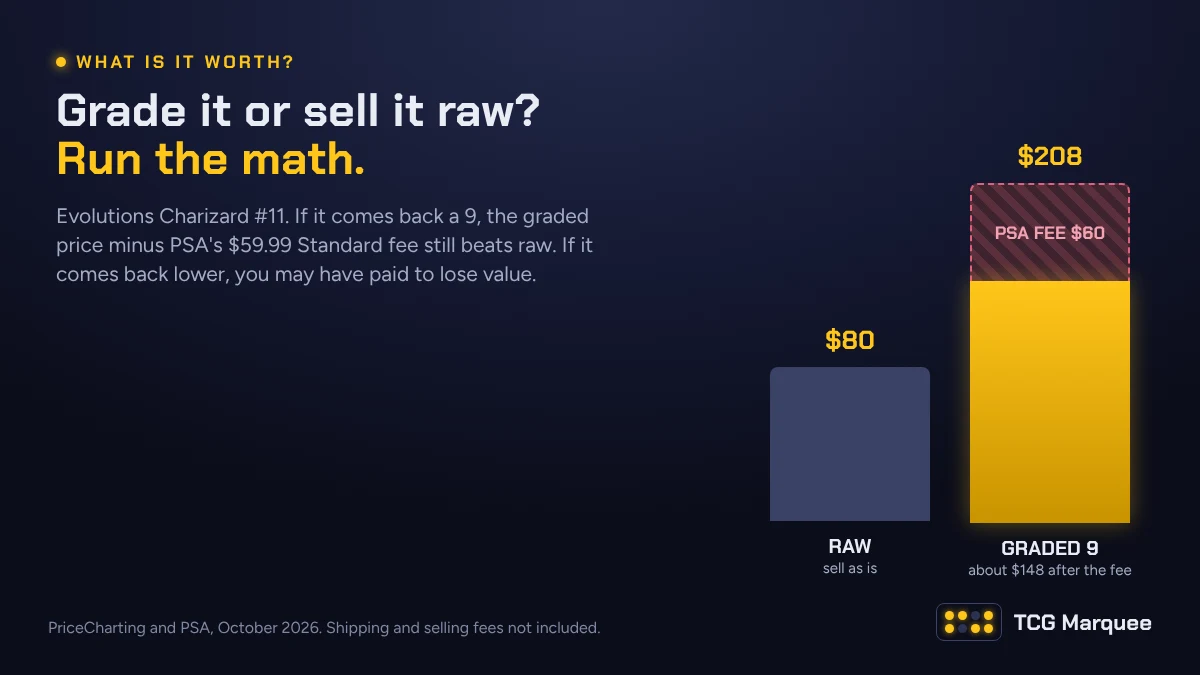
Run the math per card. As of October 2026, PSA's Value tiers were paused and its cheapest open tier, Standard, was $59.99 a card with an estimated 90 to 100 business day turnaround; Priority was $79.99 (PSA trading card grading). Shipping both ways and selling fees come on top.
A real example: the Evolutions Charizard (#11) sold for about $80.00 raw and $208.12 graded 9 in October 2026 (PriceCharting, Evolutions). If it comes back a 9, $208.12 minus the $59.99 fee is about $148, well ahead of selling it raw. If it comes back a 7, you may have paid $60 to lower its value. A $15 card is the other side: the Standard fee is four times the card, so only a near certain 10 on a card with a big 10 premium makes sense. For more on slab prices, see PSA 10 Pokemon card value.
How much is a Pokemon trainer card worth compared to Pokemon cards?
Most trainer cards are bulk, like most Pokemon. The trainers that hold value are the ones competitive players need right now, often in multiples, and older trainers that collectors chase (prize cards, special prints, top grades). Collectors price a Pokemon card mostly on the art and the character; players price a trainer on whether it's in today's decks. When a trainer drops out of play, its price can drop with it, so check recent sales rather than last season's number.
Energy cards
Basic energy is almost always bulk. Check old prints, misprints, special energy that sees play, and promos one by one, and treat the rest as filler.
Do Lorcana and other games follow the same rules?
Yes. Lorcana, Magic, One Piece, and the rest price the same way: sold listings, then condition, then grade. New sets often move fastest in their first weeks, when a card's price rests on only a handful of sales, so a release weekend price is a weak guide to next month's. Smaller games have fewer sales per card, which means one sale moves the number more. Price from the median of several sales and hold your asking price a little firmer than you would on a Pokemon staple that sells every day.
How do you value a whole collection?
Decide what the total is for first. A collection value isn't an appraisal. It tells you whether a binder is worth carrying to a show, which cards deserve a slab, and where your money sits. That sets how precise you need to be: being a little off on a hundred bulk cards barely moves the total, while one mispriced chase card can.
Step 1: Get the cards into a list
Group cards by set, then get them into an app. In TCG Marquee you can scan cards with your phone or import a CSV from another tracker, and finding cards in a big collection covers searching and sorting once they're in.
Step 2: Trust the total for bulk, check the top 10 by hand
Let the app keep a running total from daily prices. Then sort by value, take the top 10 cards, and check each one against sold listings for the exact printing and condition. Ten checks catch most of the errors that matter.
Step 3: Keep graded slabs on their own list
Value each slab from sales at its grader and grade, never from the raw price, so one mispriced slab doesn't skew the whole total.
What mistakes make people overvalue or undervalue their cards?
- Trusting asking prices. An unsold listing is a wish. Use sold listings or PriceCharting.
- Ignoring condition. A raw card with edge wear sells well below a clean copy. Judge it honestly under a bright light.
- Comparing the wrong printing. Check the number, set, stamp, and shadow before you compare. A Base Set card has no set symbol at all, and reprint sets like Base Set 2 and Evolutions carry their own symbols and numbers.
- Pricing slabs off raw comps. A graded card's price depends on its grade and on how many copies share it.
- Forgetting fees. As of October 2026, eBay's final value fee on trading cards was 13.25% of the total sale up to $7,500 and 2.35% on any part above that, plus $0.40 per order over $10 (eBay selling fees). Selling at exactly market price on eBay means keeping well under market price.
How do you price cards for a show table without looking up every card?
Put the numbers where the buyer can see them. When your asking price sits next to the current market price, buyers can check your number without pulling out a phone, and the conversation starts from your price instead of from whatever they found.
Asking price next to market price
A buyer who sees asking $45 next to market $41 (example prices) understands your spread without a debate. Set your asking prices before the show. The market price refreshes on its own, so you can see during the day if a card has moved past your sticker.
Slabs need their own price line
A PSA 9 and a raw copy of the same card are different items. Show the grade and the graded market price for each slab, or every table conversation starts with a correction.
TCG Marquee is built for this. Prices refresh every day for each card's printing and condition, and for slabs by grading company and grade (PSA, CGC, BGS, TAG, SGC, and ACE) on the Pro plan. Show mode puts your asking price next to the market price on a TV or screen at your table, with your logo and a QR code, and you can hide the market price on any card where you'd rather not show it. It covers Pokemon, Magic, Lorcana, One Piece, and more.
What it doesn't do: it isn't a sales history archive, so for every past sale of a card use eBay sold listings or PriceCharting, and a six figure slab still deserves a careful look at its recent sales by hand. TCG Marquee is in open beta. If you're new to selling at shows, start with becoming a card show vendor.
FAQ
What is the most valuable Pokemon card ever sold?
The Pikachu Illustrator, a 1998 promo given to winners of a Japanese art contest. A PSA 10 copy sold for $16,492,000 in February 2026 (our Pikachu Illustrator guide covers that sale), a Guinness World Record for a trading card (Guinness World Records). For your own cards, the top card depends on printing and grade, so check recent sales rather than headlines.
Does a 1st Edition stamp guarantee a card has value?
No. The stamp adds value when the card itself is wanted. A 1st Edition common from a big set can still sell near bulk, and heavy wear cuts any card's price. Check sold listings for that exact card and condition.
Do PSA 10 cards sell for more than raw cards?
Almost always, often by many times. The Evolutions Charizard sold for about $80 raw and $9,899.99 in PSA 10 in October 2026. But a 9 or lower on a card everyone hopes is a 10 can disappoint, so compare graded sales at the exact grade with raw sold listings before you submit.
Is it worth getting a cheap card graded?
Usually not. With PSA's cheapest open tier at $59.99 a card in October 2026, plus shipping, a card needs a big gap between its raw and graded prices to make the fee back. Run the math with recent graded sales first.