Becoming a Card Show Vendor: Costs and Checklist
A card show table pays when you know three numbers before you book it: what the day will cost you, your average margin per sale, and how much you have to sell to cover the cost. This guide covers applying for tables, what a table costs, a worked break-even example, what to bring, and the payment and pricing setup that makes a table worth the fee.
Key takeaways
- Work out your break-even before you rent a table: your costs for the day divided by your average margin.
- Apply as soon as a show announces its date. Many shows give returning vendors first pick, so popular ones fill early.
- Bring mostly playable singles in binders, a smaller stack of graded slabs, and a cheap bulk box for impulse buys.
- Put your asking price next to the market price where buyers can see both. They'll check their phones anyway.
- After every show, write down revenue, costs, and sell-through to decide whether to book that show again.
How do you get on a card show vendor list?
There's no central vendor list, even in a big area like Dallas-Fort Worth. Each promoter runs its own applications, usually through the show's website or Facebook page, or a form on Eventbrite, Eventeny, or Jotform. Find the shows near you, follow their pages, and apply on each one. The application page usually lists how many tables there are, the price per table, and load-in times.
What to include in your first vendor application
Promoters usually ask for your name or business name, contact details, what you sell (singles, sealed, slabs), how many tables you want, and often your sales tax permit number. Say plainly what you'll bring, like "Pokemon singles and graded cards." Promoters want a mix of vendors, and they want to know you aren't bringing junk.
If you plan to put a TV or monitor on your table, say so on the application. Some venues have rules about power, easels, and stands, and it's better to ask before load-in than at it.
How early to apply before tables sell out
Apply as soon as the show announces its date, which is often two to three months ahead. Many promoters offer the next show's tables to that show's vendors first, so a popular show can be full before it's widely advertised. If it's sold out, email the promoter and ask to be put on the waitlist. Vendors cancel more often than you'd think.
What does it actually cost to be a card show vendor?
Fixed costs: the table, travel, and food
Table fees vary a lot with the size of the show. A guide from The Card Shop Finder (fact-checked October 2026) puts tables at regional shows in VFW halls, community centers, and hotel ballrooms at $50 to $150, with some small mall and community shows charging $20 to $30, and big shows like The National costing thousands. Ask whether your table price includes a badge for a helper; some shows charge for extra badges.
Add gas and parking, and a hotel if the show is far enough away to need one. A night in a hotel can cost more than the table.
Variable costs: card fees and supplies
Card payments cost a percentage of each sale. In October 2026, Square's free plan charges 2.6% plus 15 cents for in-person tap, dip, or swipe payments, and 3.3% plus 30 cents for online payments and invoices (Square's fee page, squareup.com/us/en/payments/our-fees). Cash has no fee. If you use another card reader, look up its rate before the show.
Your first show also needs supplies: sleeves, toploaders, a tablecloth, price labels, and a cash box. After that, you're mostly just replacing what you sell.
A worked break-even example for one table
Here's one way a small one-day show can add up. Swap in your own numbers.
| Line item | Cost |
|---|---|
| Table fee | $75 |
| Gas and parking | $40 |
| Food | $15 |
| Card fees (about $700 in card sales over 20 swipes, at 2.6% plus 15 cents) | $21 |
| Total | $151 |
Want prices like these for your own cards, on your TV and refreshed daily? Claim a tester spot
You need $151 in profit, not sales, to break even. If your average margin is 25% (you paid $75 for cards you sell for $100), you need about $600 in sales before you make a dollar. Every dollar you sell past that is your profit for the day.
That's why pricing matters. Cards priced against today's market price sell faster than cards priced from last night's eBay search, and buyers stop to haggle over a fair price instead of walking past a high one.
How do you vet a card show before paying for a table?
Questions to ask the promoter
- How many people came last time? Ask for paid admissions, not a guess at "foot traffic."
- Did the vendor tables sell out, and do the same vendors come back? Vendors returning is the best sign a show pays.
- How big is the table, how many chairs do you get, and is there power?
- When is load-in: the night before, or early on show day?
- Where does the show advertise? A show with no advertising is counting on vendors to bring their own crowd.
Red flags: signs a show won't sell
- A first-year show with no vendor list published is a gamble.
- A room with more crafts and candles than cards means the crowd isn't there for cards.
- A promoter who takes only cash for tables, or won't put the refund policy in writing.
- Expensive parking. If walk-ins pay $20 to park, fewer of them will come.
Walk a show as a buyer first
Go to a show as a customer before you sell at it. Count the tables, watch which vendors are making sales, and notice whether people are buying binder singles, slabs, or sealed. You'll learn more in an hour of watching than from any guide.
What inventory should you bring to your first show as a vendor?
There's no magic ratio, but a good first table has three tiers:
- Playable singles in binders, the bulk of your table. This is what buyers flip through.
- Graded slabs, fewer of them but higher priced. Slabs catch people's attention from across the aisle, and a few sales can make your day.
- A bulk box of cheap cards ($1 to $5). Easy impulse buys, and good for kids.
For one table, a few hundred singles in two or three binders, a couple dozen slabs, and one bulk box fill the space without burying you. Price everything before you leave home. A card you can't price on the spot is a card you won't sell.
Pricing your slabs
Every buyer looking at a slab will check the market price on their phone before they pay, so your asking price has to hold up next to that number. Put your asking price on the slab or a card next to it, know the market price, and expect to negotiate in the gap between them. If you're asking 40% over market, most buyers won't bother to counter.
What payment, pricing, and display setup do card show vendors need?
Payment: cash and a card reader
Take both. Bring a cash box with plenty of small bills, and a card reader for everyone else.
Venues often have weak cell signal and crowded Wi-Fi, so learn how your reader handles that before show day. Square's offline mode, for example, lets you set a maximum amount for offline payments, gives a Square Reader 24 hours per offline session, and needs the payments uploaded within 72 hours or they expire. You won't know about a declined card until you reconnect, and Square says you're responsible for declined, expired, or disputed offline payments (Square's offline mode help page). For a big slab, wait until you have signal.
Sales tax: Texas and other states
In Texas, anyone selling taxable items at fairs, markets, and shows needs a Texas sales and use tax permit, and the permit is free. The occasional sale exemption that covers someone selling a few personal items doesn't apply at flea markets and shows where vendors pay to take part. Promoters can be held responsible for taxes on sales by vendors without permits, which is why so many ask for your permit number. See the Texas Comptroller's guide, Fairs, Festivals, Markets and Shows. Every state has its own rules, so check with your state's tax office before your first show. This isn't tax advice.
Why a visible price board helps sell slabs
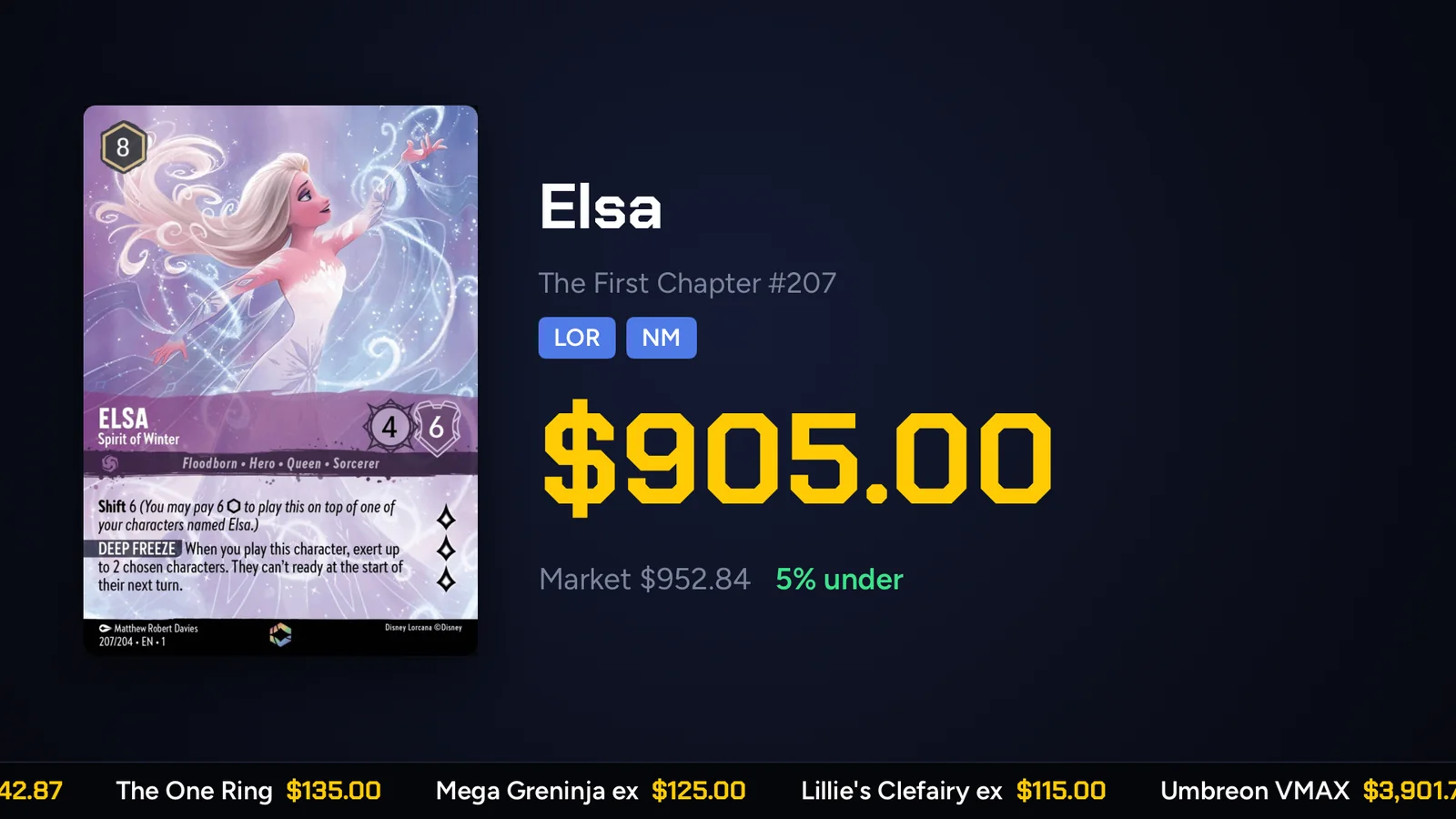
A buyer holding a PSA 9 wants two numbers: your asking price and the market price. When both are on a board behind your table, the haggling starts from a number you both can see instead of from a guess. Vendors who only say "make me an offer" lose the buyers who don't like to haggle.
Show mode: your cards for sale on a TV
This is what TCG Marquee's show mode does. It's part of the Pro plan. Mark the cards you're selling, with your own asking price or "at market," and the screen rotates through only those cards: your asking price large, with the market price and your discount underneath. Prices update automatically every day for each card's printing, condition, and grade. A for-sale total replaces your collection's value, so your whole collection's worth isn't on display. It runs on a TV, monitor, or tablet (screen mode), and it can show your shop logo and a QR code to your website or socials.
Getting ready is quicker if you scan your cards with your phone and mark a whole binder for sale at once.
What it doesn't do: it isn't a point of sale and doesn't take payments, and it isn't a sales history archive. For past sales, check eBay sold listings or PriceCharting. TCG Marquee is in open beta, so try it on your own binder at home before you count on it at a table. You can ask for an invite.
What are the most common first-time card show vendor mistakes?
Five mistakes catch most first-timers: bringing too many raw cards, no change in the cash box, prices that don't change, a table in a bad spot, and not applying for the next show. Apply for the next one before your first one ends, because tables fill and you'll lose momentum.
Pricing mistakes that cost you trust
Prices written the night before can be stale by lunch. Say you're asking $120 for a slab that PriceCharting has at $95. Any buyer with a phone will see that, and some will walk instead of asking. Show your asking price next to the market price and you look honest instead of hopeful.
Bringing cards nobody at that show buys
Don't bring 4,000 raw commons hoping one moves. Check the show's social media for what its crowd collects, bring more of the game that show draws, and keep raw bulk to one box. Binder singles and slabs sell; boxes of unsorted cards don't.
Not tracking what sold
Write down every sale, or you'll restock what didn't move and forget what did. Note which prices sold and which didn't, and adjust before the next show.
How do you know if vending at card shows is worth it?
Three numbers to write down before you pack up
Write down your total sales, your total costs (table, travel, food, hotel), and your sell-through rate (cards sold divided by cards brought). Two shows can each make $600 on $250 of costs, but one sold 40% of the table and the other sold 10%. The first is a show worth repeating. The second probably got lucky with one slab.
Note which price ranges sold, too. If your $5 binder cards sold and your slabs sat, bring more cheap singles next time, and check whether those slabs were priced above market.
When to rebook and when to try a different show
Book again when the profit was worth your time and you sold a meaningful share of what you brought; a third or more is a good sign. Try somewhere else when the room was slow, the crowd wanted sealed and you sell singles, or another vendor undercut you all day. Two weak shows at the same event means drop it. One weak show at a new event is worth a second try before you decide.
FAQ
How much does it cost to be a vendor at a card show?
Tables at regional shows usually run $50 to $150, some small community shows charge less, and big shows charge much more (The Card Shop Finder, October 2026). Add gas, parking, food, and possibly a hotel. Card payments cost a percentage of each sale: in October 2026, Square's free plan charges 2.6% plus 15 cents per in-person payment.
How do I become a card show vendor in Texas?
Find each show's vendor application on the promoter's website, Facebook page, or an Eventbrite, Eventeny, or Jotform listing, since there's no central list. Apply as early as you can. Get a Texas sales and use tax permit from the Texas Comptroller before you sell; it's free, and many promoters ask for the number.
What should I bring to my first card show as a vendor?
Singles in binders, some graded slabs, and a small bulk box for $1 to $5 impulse buys. Also pack a cash box with small bills, a card reader, a tablecloth, supplies, and inventory that's already priced. Price everything before you leave home.
How much inventory do I need for a card show table?
For one table, a few hundred singles across two or three binders, a couple dozen slabs, and one bulk box. That fills the table without burying you in restocking.
Do you need a license to sell cards at a card show?
In Texas, you need a sales and use tax permit to sell at shows, even if you're selling your own collection; the occasional sale exemption doesn't cover shows where vendors pay for a table. Other states have their own rules, so check with your state's tax office and read the show's application for anything else the promoter requires.