Card Show Display Case: How to Pick One That Sells
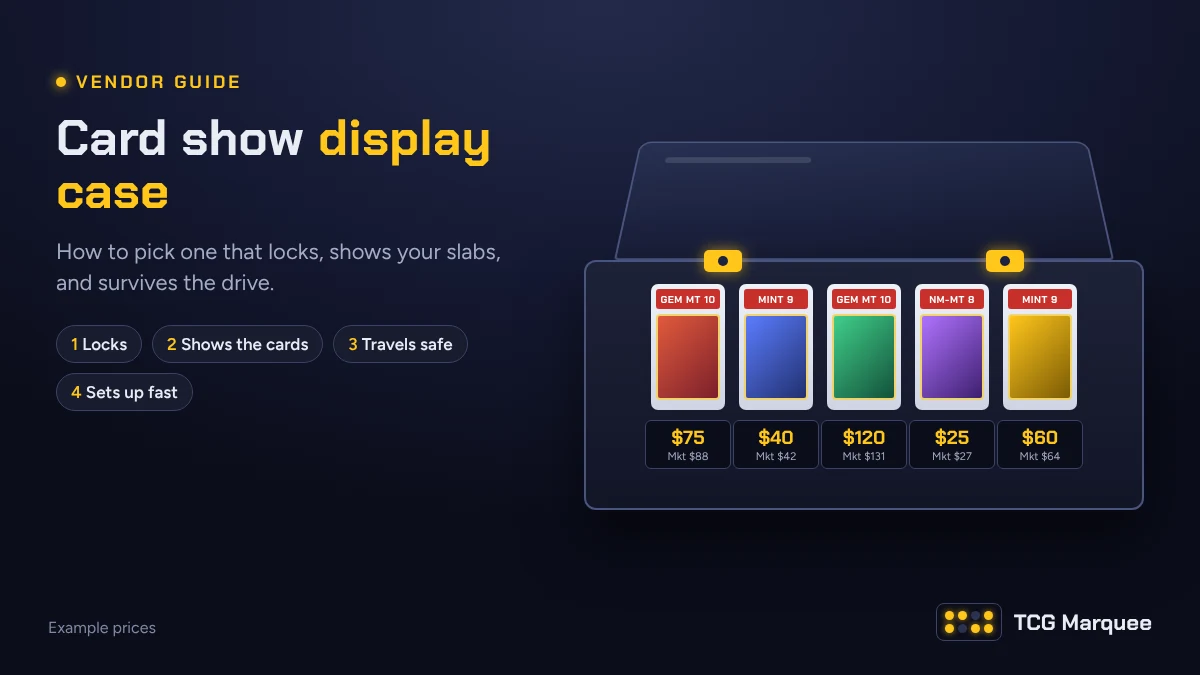
The best card show display case for most vendors is a latching case with a foam interior for storage and transport, plus a clear-lid or acrylic display on the table for the cards you most want to sell. One case rarely does both jobs well. Pick by four things: does it lock, does it show the cards, does it survive the drive, and how fast does it set up.
Key takeaways
- Splitting the job works best: a latching, foam-lined case to carry and store slabs, and a glass or acrylic display on the table for your best cards.
- Graded holders are much bigger than raw cards and vary by grading company, so measure your own slabs and check the case's interior size before you buy.
- Standing slabs upright in rows fits more per foot of table and lets buyers read labels without touching anything.
- A visible price on every card matters more to a first table than which case you bought.
- Carry slabs latched and upright, and never leave a loaded case in a parked car.
What makes a good card show display case?
A good case does four jobs: it locks, it shows the cards, it survives the trip, and it sets up in minutes. Miss one and the table pays for it.
Security at a busy table
A crowded show means hands reaching over your table all day. Look for a lid that latches or locks, latches that don't pop open with a quick lift, and a design where cards can't be slid out the side while the lid is closed. A lock won't stop a determined thief, but it stops the easy grab while you're making change for someone else.
Visibility: glare and angle
Slabs are usually your most expensive stock, so buyers want to read the grade and see the card, not a reflection of the hall lights. Rows that tilt back toward the buyer read better than slabs lying flat, and an acrylic lid should sit high enough that it doesn't rub the holders.
Transport and setup
A case that takes 20 minutes to unpack costs you the first buyers of the day. Foam rows that hold slabs snugly mean you can carry the case, open it, and be selling. Weight matters too if you park far from the hall: a heavy wood case with glass is a two-trip item.
Which case types work best?
Most vendor tables use some mix of four kinds of case. This is how they compare in general; check the listing for the exact model you're looking at.
| Case type | Lock | Weight | Setup | Cost |
|---|---|---|---|---|
| Latching storage case (foam rows) | Latches; some take a padlock | Light to medium | Open it and go | $$ |
| Glass or acrylic top wood case | Some lock, many don't | Heavy | Slower, often two trips | $$$ |
| Tabletop acrylic stands and cases | Usually none | Very light | Instant | $ |
| DIY build | Only what you add | Varies | Varies | $ |
Want prices like these for your own cards, on your TV and refreshed daily? Claim a tester spot
Latching storage cases
These carry and store slabs safely, which is most of the battle. BCW's Graded Latching Case with 3 rows, for example, lists a double latch, a dense foam interior, an interior row size of 3 3/8 by 5 5/8 inches for PSA, BGS, SGC, CSG, and HGA holders, and a slot for a tracker such as an AirTag. In October 2026 BCW listed it at $107.99 and back-ordered (BCW). The tradeoff is display: slabs sit down in foam rows, so buyers see the tops of the labels, not the cards. Many vendors open one on the table behind a display case and pull slabs from it on request.
Glass or acrylic top wood cases
These look the part. Slabs lie face up under a clear lid at reading height, which suits your best few cards. They're the heaviest option and many have no lock, so keep them within arm's reach, and use a latching case to carry the slabs to and from the show.
Tabletop acrylic stands and cases
Cheapest, lightest, and they set up in seconds. Most have no lock, and thin acrylic cracks if a box gets stacked on it in the trunk. They work best for a short row of top sellers right in front of you.
DIY builds
A wood frame with acrylic sheets, or a repurposed tool or tackle case with foam cut to fit, can cost very little. You control the layout, but you supply the lock, the padding, and a way to carry it safely.
How do you fit graded slabs?
A raw card is 63 by 88 mm (2.5 by 3.5 inches). A graded holder is a lot bigger and thicker than that, and PSA, BGS, CGC, and SGC holders aren't all the same size. That's why "fits most graded cards" in a listing is worth checking against your own stock.
Two ways to check before buying:
- Measure one of your slabs from each grading company, width, height, and thickness, with a ruler.
- Compare it with the case's interior size, not the outside size. BCW's interlocking graded card frame, for example, lists slabs up to 3 7/16 by 5 1/2 inches, and up to 5/8 inch thick (BCW).
If a listing gives only the outside size, ask the seller or skip it.
Upright or flat?
Upright rows win at most tables: buyers read labels without touching anything, and you fit more slabs per foot of table. Flat display under glass suits a handful of high value slabs you want face up, but it takes about twice the table space for the same number of cards. Keep your best sellers upright and near your prices.
Labels under hall lighting
Overhead lights glare off slab faces. Tilt rows a little, or angle an acrylic lid a few degrees away from the lights. Walk around to the buyer's side of the table after setup and look at your slabs the way they will.
How much should you spend on a card show display case?
There's no right number, but there is a sensible order.
- First show: spend on a way to carry slabs safely and a few inexpensive tabletop stands. Bring a padlock even if you plan never to leave the table. You will.
- Regular vendor: once you're doing shows most months, a good latching case and a proper display case pay for themselves in fewer dinged corners and faster setup.
- Shop counter: a locked counter case runs all day, every day, so it's worth more than a travel case. Put your highest value singles in it and leave binders out for browsing.
If you're still deciding whether to table at all, the card show vendor guide covers table fees, card readers, sales tax permits, and a break-even example.
What setup checklist do experienced vendors use?
Table layout and sightlines
- Put your best sellers at the front edge, upright, where people stop.
- Face binders outward so a buyer can flip without asking you to turn them around.
- Keep the latching storage case behind the table, closed, within reach.
- Leave a small clear spot for the buyer to look at a card and for your card reader.
A price on every card
The habit that separates busy tables from quiet ones is a price on every card before anyone asks. Most walk-up buyers have already looked up a market price on their phone. If your price isn't visible, many assume it's high and keep walking.
Printed tags or a small printed sheet work. Refresh them before each show, because raw singles can move in a week. Showing your asking price next to the market price makes a fair price obvious, and lets a buyer see a discount without doing the math.
Teardown
Pack slabs back into foam rows, never loose. Take a photo of your table before teardown, so the next setup is a copy, not a puzzle.
How do you show prices without flipping through a binder?
Handwritten tags work until a price moves overnight and your tag is stale, or a buyer asks what a slab is worth and you're scrolling sold listings mid-sale. A screen on the table can do the lookup for you.
That's what show mode in TCG Marquee is for. You mark the cards you're selling, set an asking price or leave it at market, and a TV, tablet, or monitor at your table rotates through them with your asking price large and the market price and discount underneath. Prices refresh automatically every day, for the right printing and condition, and for graded cards by grade. Show mode, graded prices, and a shop page with your logo and a QR code are on the Pro plan.
If you'd rather not show the market price on a card you're asking over market for, you can hide it per card. You can add cards by scanning them with your phone instead of typing them in.
What it doesn't do: it needs power and a screen at your table, which a printed sheet doesn't. It shows prices, not a record of what sold, so keep your own sales log. TCG Marquee is in open beta, so test it at home before you trust it at a show. A good case still matters: the screen doesn't stop anyone reaching into an open tray.
Which display ideas work for home walls and shop counters?
Home display walls
Wall frames made for slabs let you build a display that grows a frame at a time. Keep cards out of direct sunlight, which fades them over time, and arrange by set or grade so the wall reads as a collection, not storage. A small screen in screen mode next to it can show the collection's value and the week's movers.
Small shop counters
A locked case near the register holds the high value singles, and open trays or binders carry the browsing stock. A screen behind the counter with asking price next to market price helps with trade-ins, since both sides see the same number. Rotate the case each week so regulars see something new.
How do you transport a loaded case without damage?
Padding
Empty a display case before travel whenever you can. Loaded shelves shift on every turn, and a loose holder hitting another holder is how corners get scuffed. Slabs belong in a latching case with foam rows, carried latched and upright, not flat. Raw singles ride in toploaders inside a snug box, and binder stock stays in binders.
Car and hotel security
Never leave cards visible in a parked car, and don't leave a loaded case in the car overnight. Bring it into your room. A tracker inside the case, such as the slot in BCW's latching case, helps if it ever goes missing. At the table, keep the case behind you until setup is done and the display is closed.
FAQ
What do I need for my first card show table?
A safe way to carry slabs, a few tabletop stands or a simple display case for your best cards, binders facing the aisle for singles, a price on everything, and a padlock. First tables struggle more often from missing prices than from the wrong case.
Are locking display cases worth it?
Yes, the moment you step away from the table, even for a minute. If you never leave the table, a lock is less important, but busy shows make that hard to promise. Many regular vendors treat a latching or locking lid as standard.
How many slabs fit in a card show display case?
It depends on the case and on which slabs you carry. Upright rows fit far more than flat display. Check the listing's interior row size against your own slabs, and remember that holders from different grading companies differ in size.
Can I use a sports card display case for Pokemon and One Piece cards?
Yes. Pokemon, Magic, One Piece, and sports cards are close to the same size, and a graded holder is a graded holder, so the same cases work. What changes is how often prices move: modern game singles can reprice quickly, so a printed sheet goes stale faster.