Original Pokemon Cards: What Your 1999 Collection Is Worth
What your original Pokemon cards are worth comes down to four things: which 1999 era sets and printings you hold, the condition of each card, whether grading adds money after fees, and what copies actually sold for. Work through them in that order and you get a collection value you can defend across a table, instead of "worth something, probably."
Key takeaways
- The set and the printing decide most of a 1999 era card's value. A 1st Edition stamp or a shadowless Base Set card can be worth several times the Unlimited copy.
- Most of an old binder is bulk. The money sits in a few dozen holos and 1st Edition cards, so pull those first.
- Judge condition yourself before you pay for grading: centering, surface, edges, corners.
- Grading pays when a card is likely to come back a 9 or better and the graded price minus the fee clearly beats the raw price.
- Price from sold listings for the exact printing and grade, never from asking prices.
Prices and fees in this guide were checked in October 2026. They change, so look up your own cards before you quote a number.
Which original Pokemon cards carry value, and which are bulk?
The four Wizards of the Coast sets most people mean by "original" are Base Set, Jungle, Fossil, and Team Rocket. In each one, the holo rares carry most of the value, and the 1st Edition printing of each holo sells for several times the Unlimited copy. Commons and uncommons from the same sets are mostly bulk unless they carry a 1st Edition stamp or a known error.
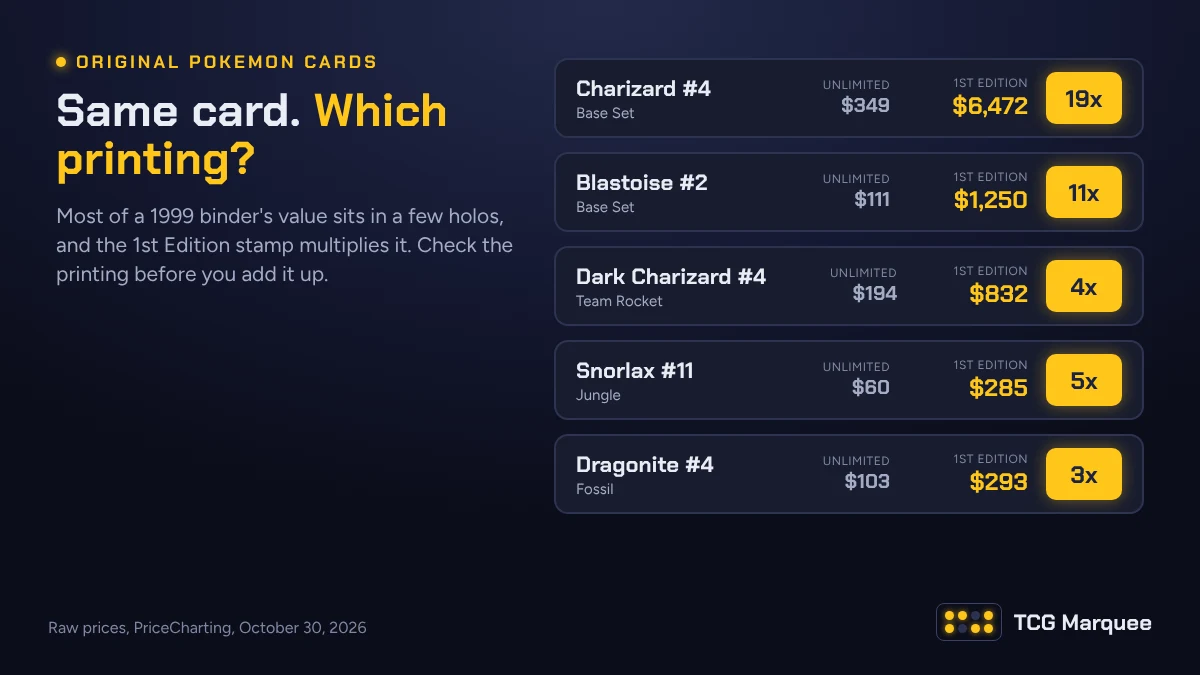
Here's how far apart the printings sit for one headline holo from each set (PriceCharting, raw prices, October 30, 2026):
| Set | Card | Unlimited raw | 1st Edition raw |
|---|---|---|---|
| Base Set | Charizard #4 | $348.75 | $6,472.44 |
| Base Set | Blastoise #2 | $110.63 | $1,250.00 |
| Jungle | Snorlax #11 | $59.96 | $285.27 |
| Fossil | Dragonite #4 | $102.94 | $292.50 |
| Team Rocket | Dark Charizard #4 | $194.09 | $832.12 |
Want prices like these for your own cards, on your TV and refreshed daily? Claim a tester spot
Base Set has a third printing in the middle: shadowless, the early print run without a drop shadow beside the art. A raw shadowless Charizard was $1,054.05 the same day. Jungle and later sets were never shadowless, so that check only applies to Base Set. Jungle's own holos still pay: the Jolteon guide shows which printings of one of them are worth money. Our shadowless guide and 1st Edition guide go through the tells, and the rarity symbols guide explains the circle, diamond, and star in the corner.
Later Wizards sets (Gym Heroes, Gym Challenge, the Neo sets) have their own valuable holos, so don't bulk them without a check. Look up the Jungle, Fossil, and Team Rocket pages sorted by price to see which cards lead each set.
How do you tell which printing you have?
Three checks place almost any original card. First, the stamp: a 1st Edition card has a small "Edition 1" stamp just under the bottom left corner of the artwork. Second, for Base Set only, the shadow: look along the right edge of the art box. Shadowless and 1st Edition Base Set cards have no drop shadow there; Unlimited cards do. Third, the copyright line along the bottom: 1st Edition and shadowless Base Set cards read "©1995, 96, 98, 99 Nintendo, Creatures, GAMEFREAK", Unlimited cards drop the final "99", and the late print reads 1999-2000.
Base Set has no set symbol at all, which is itself a tell. Jungle, Fossil, and Team Rocket each have a symbol at the bottom right of the artwork. A Base Set card with a 1st Edition stamp and a shadow is a problem: the real 1st Edition run had no shadow, so the stamp was added later.
How do you judge condition before paying for PSA?
Grade your own cards first, under bright, neutral light, with clean hands. Check the same four things a grader checks, and be strict. Over-grading your own binder is the fastest way to lose money on a submission.
- Centering. Compare the borders left to right and top to bottom, front and back. PSA's standard for a Gem Mint 10 is centering within about 55/45 on the front and 75/25 on the back, and lower grades allow more. PSA lists the tolerance for each grade on its grading standards page.
- Surface. Tilt the card under the light and look for scratches, print lines, and dents. Holo foil shows wear first.
- Edges. Look for white chipping, especially along the back, where dark blue shows every nick.
- Corners. All four, front and back. One soft corner is enough to cost a grade.
Cards kept in old binders often have ring dents near the spine and scuffs from sliding in and out of pockets. Cards kept in sleeves usually fare better. If your collection is spread across boxes and binders, sort it first; our post on finding cards in a big collection shows how we handle a big pile in the app.
When is grading worth the fee for old cards?
Grading pays only when the graded price minus every cost clearly beats the raw price. Costs are the submission fee, shipping both ways with insurance, and the selling fees when you sell. In October 2026, PSA's lowest open tier was Standard at $59.99 a card, with its Value tiers paused (PSA services and pricing). Check the page before you send anything, since tiers and prices change.
One card, real numbers
Take the Unlimited Base Set Charizard from the table. On October 30, 2026, PriceCharting showed $348.75 raw, $3,653.01 in grade 9, and $26,313.57 in PSA 10. If yours comes back a 9, grading pays many times over. The catch is how few old cards get there. For the 1st Edition Charizard, PriceCharting's population figures in late October 2026 showed 5,383 copies graded by PSA, of which 729 were PSA 9s and 123 were PSA 10s. That's about one in six at 9 or better, and those were cards owners thought were worth sending.
Grade or sell raw
Ask three questions:
- Does the card look like a 9 or better under a bright light, on all four checks?
- Is the grade 9 price far above the raw price, not just a little above it?
- After the fee, shipping, and selling fees, is the gain still worth the wait?
If any answer is no, sell it raw or keep it. A $30 holo rarely makes sense to grade. Our PSA 10 value guide shows how to price a slab once you have one.
How do you work out your original Pokemon card collection value?
Value an original collection from the top down: pull the few cards worth real money, price each one from sold data for its exact printing and condition, then treat everything else as bulk sold by the lot. For most 1999 era binders, a few dozen cards carry the total, so that's where your time should go.
Step 1: sort by set and pull the hits. Split the cards by set symbol (and no symbol, for Base Set). Pull every holo, every 1st Edition stamp, and every shadowless Base Set card into their own pile.
Step 2: sort the hits by condition. Three piles: clean candidates for grading, played cards, and anything creased, bent, or water damaged. A crease takes a card out of grading range and cuts its raw price hard, so be honest.
Step 3: price each hit. Search the exact card, number, and printing. Filter eBay to sold listings and read the middle of the last several sales, then cross-check PriceCharting for the same printing and grade. Slabs get priced at their own grade, never from the raw number.
Step 4: add it up and sanity check. If one card is more than half your total, check that price again. That one card is where a wrong printing or a wrong grade does the most damage.
Then add the bulk. A buylist or local shop will make an offer on the lot; ask what percentage of market they pay before you hand anything over.
How do fakes and reprints change the value?
A fake counts for nothing, so screen the hits before you add them up. Compare each one side by side with a card you know is real from the same set: the font and spacing of the name and HP, the color of the yellow border and the blue back, the feel and stiffness of the card stock, and the holo pattern, which on real cards has texture rather than a flat rainbow sheen. A card that fails any of those needs a closer look before it goes into your total.
Watch for the honest mix-ups too. An Unlimited card is not a shadowless card, and a 1999-2000 late print is neither. Pricing an Unlimited Charizard as shadowless puts about $700 of value into your total that isn't there (October 30, 2026 prices above). For a big card, a graded slab settles both questions at once, since the grader checks it's real and names the printing on the label. Our 1st Edition Charizard guide covers the most faked card of all.
Should you sell original Pokemon cards at auction, to a buylist, or at a show?
Each route trades price against speed. An eBay auction or listing reaches the most buyers, but the fee comes out of the sale: in October 2026, eBay's final value fee for trading cards was 13.25% of the total up to $7,500, plus $0.40 per order over $10 (eBay selling fees). Then add shipping and the time to list and pack.
A buylist or local shop pays less than market but pays today, for the whole lot, with no listing or shipping. A show table keeps your full asking price, but cards only move when the right buyer walks up.
| Route | What you keep | Speed | Best for |
|---|---|---|---|
| eBay | Sale price minus about 13% and shipping | Days to weeks | Single hits with demand |
| Buylist or shop | A percentage of market, ask first | Same day | Bulk and played cards |
| Show table | Your asking price | When the right buyer walks up | Hits buyers can see and check |
Buyers at a show check prices on their phones. TCGplayer's Market Price is built from recent completed sales on TCGplayer (TCGplayer help), so if your asking price is far above it, expect to be asked why. Our guide to price sources compares the main ones.
How do you keep the value current?
Old card prices move every week, so an original Pokemon card collection value worked out once in a spreadsheet goes stale fast. Re-checking 200 cards by hand takes an evening, and most people stop doing it.
TCG Marquee keeps the total current for you. You can scan your cards with your phone, slabs included, and prices refresh every day for each card's printing and condition, with graded prices on the Pro plan. For a show table, show mode puts your asking price next to the market price on a TV or monitor. What it doesn't do: it isn't a record of what sold, so for comps you still check eBay sold listings and PriceCharting.
FAQ
How much is a complete 1999 Base Set worth?
It depends almost entirely on the printing and condition of the holos. In October 2026, an Unlimited Charizard alone was about $349 raw on PriceCharting, and a 1st Edition Charizard about $6,472 raw. A 1st Edition set in high grades runs far higher than an Unlimited set of played cards. Price the 16 holos one by one and treat the commons as bulk.
Are shadowless Base Set cards worth more than Unlimited?
Yes. Shadowless cards come from the early print run, before the drop shadow was added beside the art, and they sell well above Unlimited copies. In October 2026, a raw shadowless Charizard was about $1,054 on PriceCharting against about $349 for Unlimited. Only Base Set has a shadowless printing.
Is it worth getting cheap original Pokemon cards graded?
Usually not. In October 2026, PSA's lowest open tier was $59.99 a card before shipping, which is more than many old holos sell for raw. Grade a card when it looks like a 9 or better and the grade 9 price is far above the raw price.
What should I do with a binder of old commons and uncommons?
Pull anything with a 1st Edition stamp, any shadowless Base Set card, and any known error first, then price those one by one. Sell the rest as a lot to a buylist or local shop, and ask what percentage of market they pay before you agree.
How can I tell if my Charizard is 1st Edition?
Look for the small "Edition 1" stamp just under the bottom left corner of the artwork. A real 1st Edition Base Set Charizard also has no drop shadow beside the art and a copyright line that ends in "99". A stamp on a card with a shadow means the stamp was added.