Best Pokemon Card Collection Tracker: 4 Apps Compared
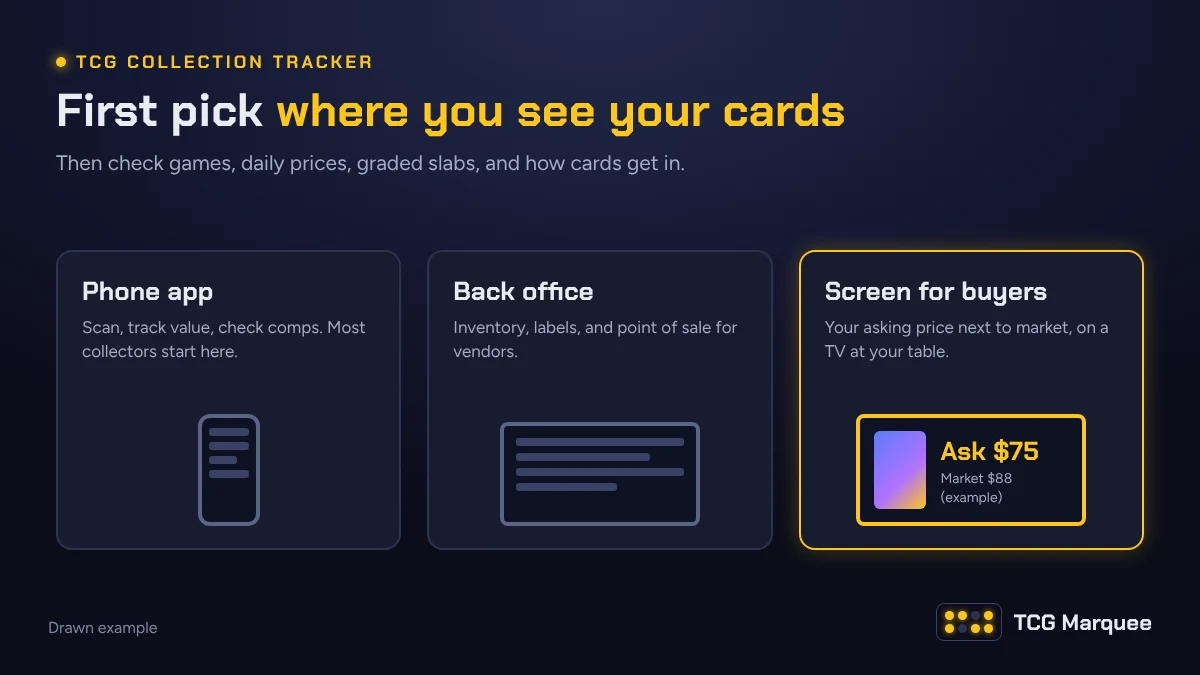
The best Pokemon card collection tracker depends on two questions: where you want to see your cards (on your phone, in a vendor back office, or on a screen buyers can read), and whether you need daily prices or just a list. Answer those first, then check that the tracker covers your games, your graded slabs, and the way you add cards.
Key takeaways
- A tracker that refreshes prices every day is a pricing tool. One where you type in prices by hand is an inventory list.
- Graded slabs need their own prices. A PSA 10 and a raw copy of the same card are different items, so the tracker should store the grader and the grade.
- Camera scanning saves hours on a big collection, but test it on your own cards, sleeves and slabs included, before you commit.
- Check game coverage for the newest sets you collect, not just the game's name on the box.
- Most trackers live on your phone. If you sell at shows, decide whether buyers should see your prices too.
What other apps offer comes from their own pages, checked October 30, 2026. They change, so look at each one yourself before you pick.
What should a Pokemon card collection tracker do?
A TCG collection tracker should do three jobs: tell you what each card is, tell you what it's worth today, and add that up into a collection total you trust. The first job is identification (set, number, printing, condition, grade). The second is prices that update on their own. The third is a total that moves when the market moves, so you're not pricing from memory.
Vendors have a fourth job: showing buyers a price they believe. Buyers check prices on their phones mid-deal. If the number behind your table and the number they find match, the haggle is short. Our guide on what TCGplayer Market Price means explains the number most buyers look up.
Live prices or manual entry?
Prices get into a tracker one of two ways. Either the app looks up each card and refreshes its price on a schedule, or you type in what you paid or what you think it's worth, and that number sits there until you change it.
Manual prices are fine for an insurance list. They don't work for selling, because the market moves between the morning setup and the afternoon. If your sign says $40 and the market dropped to $28, the card sits all weekend. If it went to $55, you gave money away.
How cards get in: scanning or typing
Adding cards is a separate question from pricing them. Camera scanning is fastest for a stack of raw singles: point the phone, check the match, next card. Typing a card in by set and number is slower but never misreads a card. Most good trackers now offer both.
Scanners can struggle with glare from sleeves, top loaders, and slab cases, so try any scanner on your own cards in the way you store them. Good light and a plain background help any scanner. For slabs, check whether the scanner reads the grader and grade from the label, or whether you'll set them by hand.
How do you track graded cards?
Store each slab with its grading company and grade, and price it from sales of that exact grade. The gap between grades is big enough that a raw price on a slab is meaningless. In October 2026, PriceCharting showed the Unlimited Base Set Charizard #4 at $348.75 raw, $3,653.01 in grade 9, and $26,313.57 in PSA 10 (PriceCharting, Base Set).
When you compare trackers, look at which graders each one prices. PSA, CGC, and BGS are the big three, but TAG, SGC, and ACE slabs turn up at shows too. Our PSA 10 value guide walks through pricing a slab, and the guide to price sources covers where graded comps come from.
Which collection tracker apps are worth a look?
Four tools come up again and again, and they do different jobs. Here's what each one's own site says, checked October 30, 2026.
| Tool | Built for | Games listed | Camera scanning | Graded prices | Screen for buyers |
|---|---|---|---|---|---|
| TCGVisor | Collectors, free app | Pokemon, Magic, One Piece, Lorcana, Gundam, Riftbound, Pokemon TCG Pocket | Yes, free scans each week | Yes, PSA, BGS, CGC, TAG | Not described |
| Collectr | Collectors, portfolio app | Pokemon, Magic, Yu-Gi-Oh!, One Piece, Lorcana, and 20 more | Yes, unlimited on Pro | Yes, with pop reports | Not described |
| Double Holo Vendor Hub | Vendors, back office and point of sale | Not listed on the page | Slab scanner, stack scanning for deals | Graded inventory | Not described, prices reach buyers on labels |
| TCG Marquee | Collectors and vendors who want a screen | Pokemon, Magic, Lorcana, One Piece, Gundam, Riftbound | Yes, cards and slabs | Pro: PSA, CGC, BGS, TAG, SGC, ACE | Yes, show mode on a TV or monitor |
Want prices like these for your own cards, on your TV and refreshed daily? Claim a tester spot
TCGVisor is free with unlimited cards. Its page says prices come from TCGplayer and eBay, refreshed daily, with raw prices split by condition. CSV import is free; CSV export, longer price history, and more scans are in its Pro tier.
Collectr says each card is valued daily from real sales data, with raw and graded comps, pop reports, and up to five years or more of price history. Pro is $4.99 a month billed yearly, or $7.99 monthly, and adds unlimited scanning and data export.
Double Holo's Vendor Hub is a business tool: inventory for raw, graded, and sealed product, a point of sale for buys, sells, and trades, price labels that flag when the market moves past your sticker, and listing sync to eBay and Shopify on higher plans. Vendor Free covers 50 active items; Basic is $16.67 a month billed yearly ($24.99 monthly).
For a longer side by side with each one, see TCG Marquee vs TCGVisor, vs Collectr, and vs Double Holo.
PriceCharting isn't on the list as a tracker here; we use it as a price guide to check numbers, as the links in this post show.
Where does our app fit, and where does it fall short?
We built TCG Marquee for people who want their cards on a screen they don't have to pick up: an LED board on the shelf, a TV in the card room, or a monitor on a show table. You can scan cards and slabs with your phone, prices refresh every day for each card's printing and condition, and graded prices come with the Pro plan. Show mode puts your asking price next to the market price, with your logo and a QR code, and you can hide the market price on any card.
What it doesn't do, honestly:
- It's not free. The Collector plan is $4 a month for up to 250 cards and Pro is $9 a month (October 2026 prices).
- It covers six games, fewer than Collectr lists, and no digital games like TCG Pocket.
- It isn't a point of sale and doesn't log what sold. For comps, check eBay sold listings and PriceCharting.
- Price charts go back about three months, not years.
Plenty of people will use two tools: a free phone app or a vendor back office for the paperwork, and a screen for showing the cards. You can bring a collection over with a CSV, matched by name, set, and number.
Which tracker works for One Piece?
All three of the collector-facing trackers above list One Piece, and so do we. The better test is whether the newest sets and the printing you hold are in the database. One Piece has a lot of parallel and alternate art printings of the same card, and they sell at very different prices, so search for one of your own alternate arts and one card from the latest set before you add a binder. If either is missing or priced only as the base card, the tracker will undervalue your collection.
The same goes for Lorcana, where the Enchanted and foil printings sell far above the regular card. Our Lorcana First Chapter guide shows how far apart those printings sit.
Is there a tracker for Pokemon TCG Pocket?
Pokemon TCG Pocket is a phone game, and your collection already lives in the app. There are no slabs to grade and no table to sell from, so most trackers built for physical cards skip it. Of the tools above, TCGVisor lists Pokemon TCG Pocket as a supported game with its own set browser. We only track physical cards.
If you collect both, keep them separate. A physical TCG collection tracker earns its keep on singles, slabs, and sealed product.
How do you pick the right tracker?
Run any tracker through five questions before you move a whole collection into it:
- Games. Does it list your games, and your newest sets?
- Prices. Do they refresh on their own, and does it say where they come from?
- Slabs. Does it store the grader and grade, and price that exact grade?
- Adding cards. Does the scanner read your cards the way you store them, and can you fix a wrong match?
- Where you see it. Your phone, a back office, or a screen buyers can read?
Then try it with 20 cards before you add 2,000. Export or import a CSV both ways so you know you can leave.
FAQ
Is there a free Pokemon card collection tracker app?
Yes. In October 2026, TCGVisor's page said it's free with unlimited cards, and Collectr has a free tier with Pro as an upgrade. Check what the free tier limits, usually scans, price history, or export, before you add a big collection.
How do I track the value of my graded PSA cards?
Add each slab with its grading company and grade, so a PSA 10 and a PSA 8 of the same card are separate items. Then use a tracker that prices that exact grade. Check the cert number on PSA's site if you bought the slab from someone else.
Can one tracker handle Pokemon, One Piece, and Lorcana together?
Yes, several list all three, including TCGVisor, Collectr, and ours. Check that each game's newest sets and special printings are in the database before you add a binder.
What is the best way to show prices at a show table?
Show the market price next to your asking price, with the date, so buyers can check it against their phones. A screen that updates on its own saves rewriting stickers between customers. Our card show vendor guide covers the rest of the table setup.