TCGplayer Graded Card Prices: Read Them Before You Pay
TCGplayer graded card prices are easy to misread, because TCGplayer doesn't publish a price guide for slabs. Its Market Price is built from recent sales of a product in the printing and condition you pick, and graded cards are sold there as one-off Listings with Photos. So before you pay a graded premium, price the slab from graded sales at the exact grading company and grade, not from the number at the top of the TCGplayer page.
Key takeaways
- TCGplayer says its Market Price "is compiled from recent sales completed on TCGplayer.com" and follows the printing and condition filters on the page. It is not a price per grade.
- TCGplayer graded card prices come from Listings with Photos, which are one-of-a-kind listings outside the normal condition guidelines.
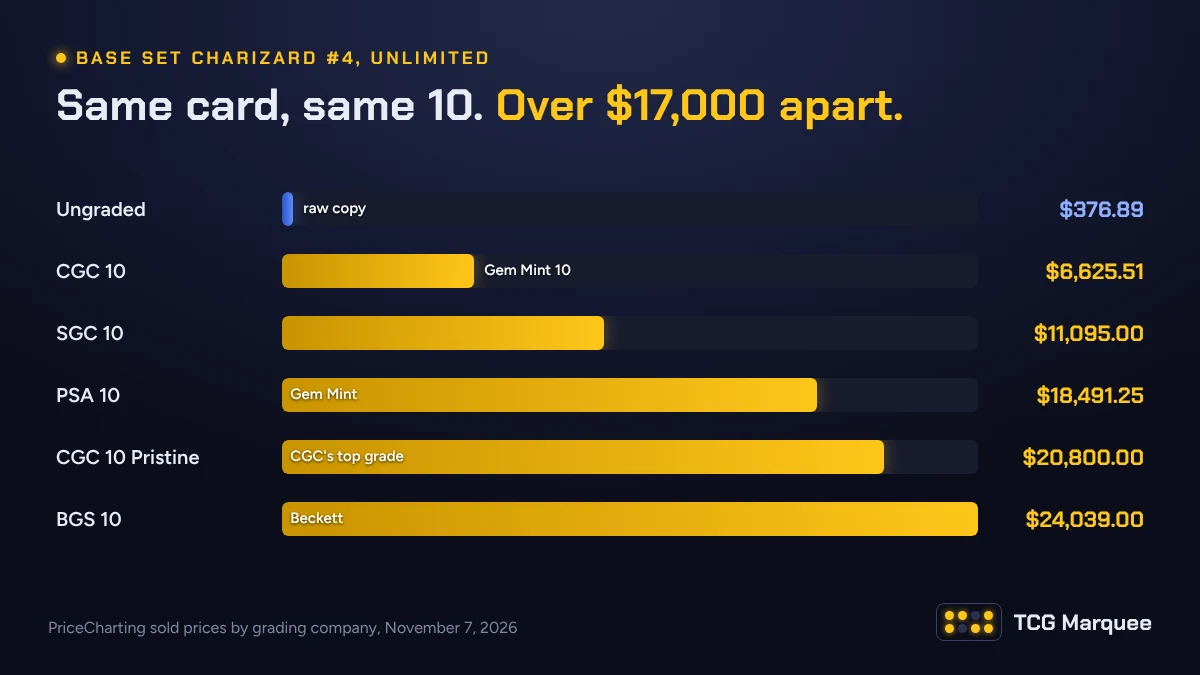
- The grading company changes the price, not just the number. In November 2026 a Base Set Charizard at a 10 ranged from about $6,600 (CGC 10) to about $24,000 (BGS 10) on PriceCharting.
- A 9 isn't always worth more than a clean raw copy. Prismatic Evolutions Umbreon ex #161 showed $1,000 at Grade 9 against $1,085.47 ungraded on PriceCharting in November 2026.
- Price a slab from recent graded sales on PriceCharting or eBay sold listings, at the same grader and grade, and check the cert number before you pay.
Does TCGplayer have prices for graded cards?
Not as a separate price guide. TCGplayer's product pages show price points such as Market Price, Most Recent Sale, and Listed Median, and TCGplayer says those "reflect any selected printings and conditions filters applied to the product page" (TCGplayer help). The conditions are things like Near Mint and Lightly Played, the grades for raw cards.
Graded slabs show up on TCGplayer as Listings with Photos. TCGplayer describes these as listings that are "rare, expensive, or one-of-a-kind" and lists graded collectibles among what sellers can post there (TCGplayer help). You can filter a product page to show only Listings with Photos (TCGplayer help). TCGplayer doesn't say whether sales of those listings feed the Market Price at the top of the page, and it doesn't show a Market Price per grade.
What Market Price does mean
TCGplayer says Market Price averages recent sales of a product and ignores outliers, and that it uses sold prices instead of asking prices (TCGplayer help). For a raw Near Mint card that's a good number. For a slab, it's the wrong question: you want what that card sold for at that grade, from that grading company. That's why TCGplayer graded card prices need a second source. Our guide to the Pokemon TCG market price explains the raw side in more detail.
Why the asking price on a slab can look high
A graded listing on TCGplayer is one seller's asking price for one copy. If it's the only PSA 10 listed, there's nothing next to it to compare. The Listed Median, which TCGplayer says comes from "listed prices only", can sit far above what copies actually sell for (TCGplayer help). So most TCGplayer graded card prices you see are asking prices. Treat a slab's price tag as a starting point for your own check.
Are graded prices the same as raw prices on TCGplayer?
No. A slab sells on its own market, and the gap between raw and graded is different for every card. Here is one card, Base Set Charizard #4 (Unlimited), priced several ways on PriceCharting on November 7, 2026 (PriceCharting):
| Charizard #4, Base Set | PriceCharting, Nov 7, 2026 |
|---|---|
| Ungraded | $376.89 |
| Grade 9 | $2,949.25 |
| CGC 10 | $6,625.51 |
| SGC 10 | $11,095.00 |
| PSA 10 | $18,491.25 |
| CGC 10 Pristine | $20,800.00 |
| BGS 10 | $24,039.00 |
Want prices like these for your own cards, on your TV and refreshed daily? Claim a tester spot
The raw price says almost nothing about the slab. A PSA 10 was about 49 times the ungraded price, and the step from a 9 to a 10 was worth more than $15,000.
A 9 and a 10 are different markets
Most of the premium sits at the top grade. Buyers pay for the number on the label and for how few copies share it, which PSA's population report counts grade by grade. So treat each grade as its own item with its own comps. A PSA 9 is not a PSA 10 with a discount.
When the slab isn't worth more than raw
On some modern cards, a 9 sells for about what a clean raw copy does. Prismatic Evolutions Umbreon ex #161 showed $1,085.47 ungraded and $1,000.00 at Grade 9 on PriceCharting on November 7, 2026, while a PSA 10 showed $4,187.50 (PriceCharting). Paying extra for a 9 of a card like that buys you the slab, not a premium.
What do PSA, BGS, and CGC grades mean for price?
The same number from a different company is a different price. On the Charizard above, a CGC 10 averaged about a third of a PSA 10, and a BGS 10 averaged more than a PSA 10.
- PSA grades on a 1 to 10 scale, with 10 the best, and seals each card in a tamper-evident case with the grade and certification number on the label (PSA).
- BGS (Beckett) gives final grades in half points: 10, 9.5, 9, 8.5, and so on (Beckett). PriceCharting tracks a BGS 10 Black label separately; on the Charizard above it showed $120,195.00.
- CGC has two 10s. Pristine 10 is its top grade, for a card that is virtually flawless with 50/50 centering, and Gem Mint 10 comes next. Its older Perfect 10 label is retired (CGC Cards).
When you price a slab, read the company first, then the grade, then pull comps for that exact pair. If a price guide shows one number for a grade without naming the company, treat it as a rough guide and check sold listings for your grader.
When is a graded card worth buying over a raw copy?
When the condition is the risk you're paying to remove. If you can't judge centering, corners, edges, and surface on a raw copy yourself, a slab from a known grader settles it. That matters most on vintage cards and expensive cards, where one grade is worth thousands.
The grading fee math
Run the math the other way too: what would it cost to grade a raw copy yourself? In November 2026 PSA listed Standard at $59.99 a card (up to $1,000 insured value), Priority at $79.99, and Express at $199.00, and its $39.99 Value tier was paused (PSA). Add shipping both ways and the chance the card comes back a grade lower than you hoped. On a $40 raw card the fee eats the whole premium. On a card that jumps by thousands at a 10, it's small.
For cheap modern cards, buying raw and checking the card in hand usually makes more sense.
What red flags should you check before paying a graded premium?
Before you trust TCGplayer graded card prices on a listing, check these:
- Photos of the card, not just the label. On TCGplayer, a Listing with Photos should show the exact slab. Look at the card through the case, front and back.
- The cert number. Type it into PSA's cert verification or the grader's own lookup and make sure the card, set, and grade match the label.
- One listing setting the price. A single slab with no sales behind it is an asking price, not a market price. Find recent sold copies at the same grade before you agree.
- The wrong comp. A price for a PSA 10 doesn't apply to a CGC 10, and a 1st Edition price doesn't apply to Unlimited. Check the edition, the grader, and the grade.
How do you check TCGplayer graded card prices before you buy?
It takes about five minutes:
- Write down the card, set, number, edition, grading company, and grade from the label.
- Look up that card on PriceCharting, which shows ungraded and graded prices on the same page, by grade and for each company at a 10.
- Search eBay sold listings for the same card, grader, and grade, and read the dates. Recent sales count most.
- Compare the seller's price with those sales. If it's well above, ask why (a better looking copy, a low population grade) or make an offer.
- Note the date you checked. Graded prices move, and a number from last month is just a guess today.
Our guide to Pokemon card price sources covers which source to use for raw singles, slabs, and Japanese cards.
How should a show vendor show graded prices?
Buyers at your table check TCGplayer graded card prices and sold listings on their phones, so a slab's sticker needs to hold up against the comp they find. Price each slab from its own graded comps, update them often, and show buyers where you stand.
This is the part I built TCG Marquee for. On the Pro plan it prices graded cards by grading company and grade (PSA, CGC, BGS, TAG, SGC, and ACE), refreshes prices every day, and show mode puts your asking price next to the market price on a TV or screen at your table, with your logo and a QR code. Graded card prices and the two plans explains how the graded side works. It's in open beta, and it isn't a sales history archive, so for every past sale of a card, use eBay sold listings or PriceCharting. If you'd like to try it, free tester spots are open.
If you keep your best slabs at home, the graded card display guide matches the case to the slab's value.
FAQ
Are TCGplayer graded card prices a price guide?
No. TCGplayer's Market Price follows the printing and condition you pick on a product page, and graded slabs are sold as Listings with Photos without a Market Price per grade. Use PriceCharting or eBay sold listings for graded prices.
Why is a PSA 10 on TCGplayer listed higher than the Market Price?
Because the Market Price you see is built from recent completed sales of the product in the condition you picked, which is usually raw. A PSA 10 sells on its own market, often for many times the raw price. Compare the listing with recent PSA 10 sales of the same card instead.
Is a CGC 10 worth the same as a PSA 10?
Usually not. On Base Set Charizard in November 2026, PriceCharting showed a CGC 10 at about $6,600 and a PSA 10 at about $18,500. CGC's Pristine 10, its top grade, was higher at about $20,800. Always compare the same company and grade.
How often do TCGplayer prices update?
TCGplayer says Market Price is updated as transactions complete. For a card that rarely sells, that can still mean a number built on very few sales, so check recent sold listings before you rely on it.
How do I know a graded card is real?
Look up the certification number on the grading company's site and check that the card, set, and grade match the label. Then look at the card itself through the case for anything that doesn't match the label.