Graded Card Display: Match the Setup to the Slab's Value
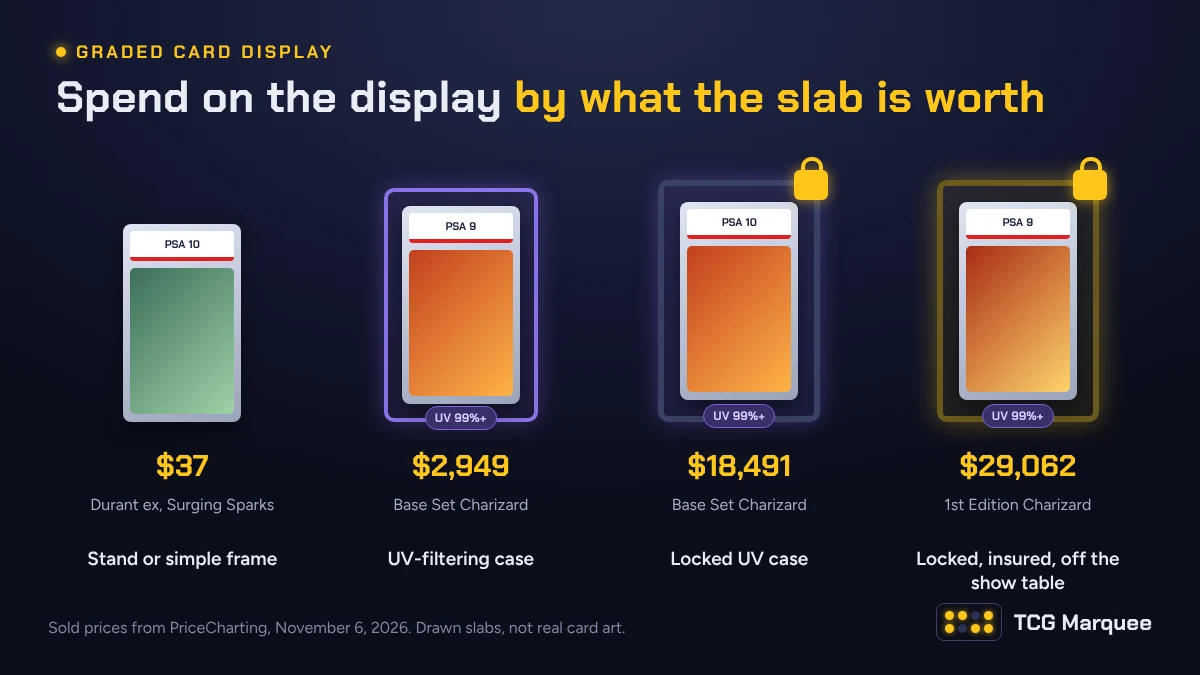
A good graded card display costs a small share of what the slab is worth. A $40 slab is fine in an inexpensive frame on a shelf. A slab worth a few thousand dollars earns a UV-filtering case away from windows, and anything you couldn't replace belongs in a locked case. Price the slab first, then pick the display, and recheck the price now and then.
Key takeaways
- Look up the slab's sold price for its exact grade before you buy a display for it. In November 2026 a PSA 9 and a PSA 10 of the same Base Set Charizard were about $15,500 apart.
- PSA, BGS, CGC, and SGC holders are not all the same size. SGC's holder is the largest of the four in one set of caliper measurements, so check a frame's fit list before you buy.
- Light damage to paper is cumulative and can't be undone. Keep slabs out of direct sun, and use LED lighting, which gives off no UV.
- Never open a slab to frame the card. PSA's holders are sonically welded and tamper-evident, and a cracked holder is a reholder job for the grader.
- At a show table, a lock matters more than UV. At home, UV matters more than a lock.
How much is the slab worth before you pick a graded card display?
Start with the price, because it decides how much protection makes sense. Look up recent sold prices for the exact card, edition, grading company, and grade, not the raw card and not an asking price. The gap between grades is often bigger than the gap between cards, so a display that's right for one copy can be wrong for another copy of the same card.
Here's how wide that range runs. All prices are from PriceCharting, built from sold listings, as shown on November 6, 2026.
| Slab | Grade | Sold price | A sensible display |
|---|---|---|---|
| Durant ex, Surging Sparks #215 | PSA 10 | about $37 | Shelf stand or a simple frame |
| Charizard, Base Set #4 (Unlimited) | PSA 9 | about $2,949 | UV-filtering case, away from windows |
| Charizard, Base Set #4 (Unlimited) | PSA 10 | about $18,491 | Locked UV case, or a safe with a display copy |
| Charizard, Base Set 1st Edition #4 | PSA 9 | about $29,062 | Locked UV case, insured, not on a show table |
Want prices like these for your own cards, on your TV and refreshed daily? Claim a tester spot
Sources: PriceCharting's Base Set Charizard, 1st Edition Charizard, and Surging Sparks pages. Graded prices move a lot: the Unlimited Charizard PSA 10 figure had dropped about $12,000 since PriceCharting's previous update. If you're pricing your own slab, our PSA 10 Pokemon card value guide walks through it.
How do you match a graded card display to the slab's value?
A simple rule works: spend a small fraction of the slab's value on its display, and add protection as the value climbs. Cheap slabs mostly need protection from scuffs and dust. Valuable slabs also need protection from light, theft, and drops. The tiers below are a rule of thumb, not a standard, so move the lines to fit your own collection and your insurance.
Under about $100: frames, stands, and storage boxes
The holder already protects the card. What you're protecting is the plastic, which scratches. A slab sleeve, a shelf stand, or a basic frame is plenty. BCW's interlocking graded card frame, for example, listed at $26.99 for a box of four in November 2026 and fits slabs up to 3 7/16 by 5 1/2 inches (BCW). BCW doesn't list UV protection for it, so keep it out of the sun.
About $100 to $1,000: UV-filtering acrylic
This is where light starts to matter, because these slabs often sit on display for years. Look for a case or frame that states how much UV it blocks, as a number. Phantom Display, for example, lists some of its slab cases at up to 99.6% UV protection and recommends acrylic rated 99% or higher (Phantom Display). "UV resistant" with no number tells you very little.
About $1,000 and up: locked, UV-filtering, and insured
Add a lock, mount it where it can't be knocked off a shelf, and keep it away from windows. For slabs in the five figures, many collectors keep the original in a safe and display a lower-grade copy or a photo. Check that your home insurance covers collectibles at that value, which may need a separate rider.
Which graded card display fits PSA, BGS, CGC, and SGC slabs?
Not every frame fits every slab. The grading companies use different holders, and the differences are a few millimeters, which is enough to decide whether a slab sits snug or doesn't fit at all. CGC says its holder is about 3.15 by 5.30 inches (CGC). PSA says its 2024 redesign kept the same outside size as before (PSA).
For the others, the most complete figures we found are third-party caliper measurements, not manufacturer specs, from PreGrade Cards:
| Grader | Height | Width | Thickness |
|---|---|---|---|
| PSA | 5.34 in | 3.16 in | 0.25 in |
| BGS | 5.15 in | 3.27 in | 0.33 in |
| CGC | 5.31 in | 3.16 in | 0.30 in |
| SGC | 5.45 in | 3.40 in | 0.33 in |
So SGC holders are not smaller than PSA's, as some guides say. In these measurements they're the tallest and widest of the four. That's why some cases list SGC as a separate fit or leave it out, and why BCW's frame above, at up to 5 1/2 by 3 7/16 inches, is one that lists SGC.
Two checks before you buy:
- Compare the frame's inside size, not its outside size, with your own slabs. Measure one from each grader you own.
- Check thickness too. BGS and SGC holders are thicker than PSA's, and a frame made for PSA can pinch them.
Can you build a DIY graded card display that still protects value?
Yes, as long as you build around the slab and never alter it. PSA's holder is sonically welded and "tamper-evident", in PSA's words, and tampering can leave frosting or cracks in the plastic (PSA). Buyers check for that, so drilling, gluing, or prying a holder costs you more than any frame saves.
A shadow box or wall frame works well if you:
- hold slabs with foam corners or a fitted insert, never glue or tape on the holder
- use UV-filtering acrylic for the front, since ordinary glass doesn't filter UV
- leave the label fully visible, so the grade and certificate number can be read and checked
- keep the box closed against dust, but easy to open if you sell
If a holder does crack or scratch badly, don't open it yourself. PSA offers a reholder service for damaged holders, submitted through its website.
Does display lighting fade graded cards?
Yes, light fades cards and labels over time, and the damage adds up. The Library of Congress says light "can cause permanent and irreversible damage" and that light damage is cumulative (Library of Congress). It also notes that visible light, not only UV, damages paper over time. A slab protects the card from handling, not from years of sunlight.
PSA describes its 2024 holders as more resistant to UV damage from the sun, which helps the plastic. It doesn't change the rule for the card inside: less light, for less time, is better.
Sunlight, fluorescent, and LED
- Sunlight is the worst: strong UV and heat. Never hang slabs where the sun reaches them, even for an hour a day.
- Fluorescent tubes give off some UV. The Northeast Document Conservation Center says most do, from 0.5% to 12% (NEDCC).
- LEDs give off no UV or infrared, according to the same leaflet, which makes them the safest lighting for a display wall. Keep them dim and switch them off when nobody's looking.
What graded card display works at a show table?
At a show the risks change. Theft and handling matter more than light, because the case is out for a day, not a year. A latching case for carrying slabs, and a locked or closed display for your best few on the table, cover most of it. Our card show display case guide covers case types, setup, and transport.
The other half of a show table is the price. Buyers check prices on their phones, so a handwritten tag that's a few weeks old can cost you a sale. TCG Marquee is a price display for collectors and vendors, now in open beta. Show mode puts your asking price next to the market price on a TV or screen at your table, with your logo and a QR code, and you can hide the market price on any card. Prices refresh every day for the printing and condition, and by grade for graded cards on the Pro plan. You can add cards by scanning them with your phone.
What it doesn't do: it shows prices, not a record of what sold, so check eBay sold listings or PriceCharting for sales history. And a screen doesn't lock anything, so the case still matters.
Which setup fits your situation?
| Situation | Display | Watch out for |
|---|---|---|
| Home wall | Frames with UV-filtering acrylic, LED light | Windows, afternoon sun |
| Shelf or desk | Slab stands, a closed case for dust | Knocks and scratches |
| Show table | Latching carry case, locked display for top slabs | Theft, stale prices |
| Shop counter | Locked counter case near the register | Glare from shop lights |
At home, a small screen in screen mode next to the wall can show what the collection is worth today, so you notice when a slab moves into a tier that deserves a better case.
FAQ
Are PSA and SGC slabs the same size for display frames?
No. In third-party caliper measurements, SGC's holder was about 5.45 by 3.40 inches, taller and wider than PSA's at about 5.34 by 3.16 inches, and thicker too. Check a frame's fit list and inside size against your own slabs before you buy.
Is it safe to take a card out of the slab to frame it?
No. Once the holder is opened, the card is ungraded to a buyer, and the grade can't be checked anymore. Frame the slab as it is, and send a damaged holder back to the grader for a reholder instead.
What is the cheapest safe way to display graded cards?
A slab stand or a simple frame on a shelf out of direct sun. BCW's interlocking frames, at $26.99 for four in November 2026, are one inexpensive option. Add UV-filtering acrylic as the slab's value goes up.
Do LED lights damage graded cards?
LEDs give off no UV or infrared, so they're the safest choice for lighting a display. Any light still adds up over years, so keep it dim and turn it off when you're not looking at the wall.
How do I find a graded card's value before choosing a display?
Look up recent sold prices for the exact card, edition, grading company, and grade on PriceCharting or eBay sold listings. Don't go by the raw price or asking prices, and recheck it now and then, since graded prices can swing by thousands.